Stripe Banned Your Account? How to Keep Accepting Payments with Crypto

Stripe banned your account? It usually happens without warning. An email from Stripe or PayPal. Your account is suspended. Funds are held for 90 to 180 days. Existing customers can’t pay. Revenue stops.
If this happened to you, you’re not alone. Stripe and PayPal have escalated enforcement on business categories they consider high-risk: web hosting, digital products, gaming, VPNs, certain software tools, supplements, and dozens more. Even long-standing accounts get swept up in periodic review waves.
This post is for merchants who need to keep operating. It covers what actually causes bans, why the standard high-risk processor alternatives have their own problems, and how crypto payments work as a structurally different solution.
Why Stripe Bans Merchants
Stripe is not arbitrary. It is a scaled business with a specific risk tolerance. When your account gets flagged, one of these is usually the cause.
You’re in a prohibited or restricted category. Stripe’s prohibited businesses list is long. Web hosting, VPNs, certain software products, gambling, adult content, and firearms accessories are restricted or outright banned regardless of your track record.
Your chargeback rate crossed a threshold. Card networks require processors like Stripe to maintain low aggregate chargeback rates. When individual merchants push their ratio above 1%, Stripe terminates the account to protect its own standing with Visa and Mastercard. Your problem becomes their problem, and they solve it by removing you.
You scaled too fast. Rapid revenue growth without matching account history is a fraud signal. Stripe’s risk systems flag accounts that go from $0 to $50,000/month without gradual ramp-up.
You’re international with specific product and country combinations. Cross-border transactions involving certain origin countries, product types, or customer bases trigger additional scrutiny.
The underlying issue is often not that you did something wrong. It’s that Stripe’s risk model is built for a specific type of business, and yours doesn’t fit it.
The High-Risk Processor Trap
The natural next step is searching for a high-risk payment processor. You’ll find options: Durango Merchant Services, PaymentCloud, Soar Payments, and others.
These processors can work. But understand the tradeoffs before signing.
Higher fees. High-risk processors charge 3-5% per transaction versus Stripe’s 2.9%. On $30,000/month, that’s an additional $600-$1,200 per month in processing costs.
Rolling reserves. Many high-risk processors hold 5-10% of your monthly volume in a reserve account for 6-12 months. If you process $30,000/month, you may have $18,000-$36,000 locked up at any given time.
Same structural exposure. You’re still on Visa and Mastercard rails. The chargeback exposure that triggered your ban doesn’t go away. You’re one bad month from the same situation at a new processor. High-risk processors have lower tolerance thresholds than Stripe. They can’t absorb your chargebacks any better.
Long approval timelines. High-risk merchant accounts often take 2-4 weeks to underwrite. If your business is down today, that timeline is a real problem.
These aren’t reasons to never use a high-risk processor. They’re reasons to evaluate whether you need to stay on card rails at all.
Why Crypto Payments Are Structurally Different
Crypto payments are not a payment processor in the traditional sense. There is no acquiring bank, no card network, and no merchant account that can be suspended.
Here is the difference in practice.
Chargebacks don’t exist. A blockchain transaction is cryptographically signed by the sender and permanently recorded. There is no bank dispute mechanism. The 1% chargeback rate that ended your Stripe account is irrelevant on-chain.
No merchant account to terminate. Crypto payments don’t route through card networks. You connect your own wallet. There is no underwriting, no approval process, and no account that can be closed.
Your wallet is yours. A crypto wallet is controlled by your private keys. No payment company can freeze it, terminate your access, or hold your funds pending a review.
No rolling reserves. Payments go directly to your wallet. There is no intermediary sitting between your customer and your funds.
For merchants whose core problem is chargeback-driven bans or high-risk category restrictions, crypto removes the structural cause of those problems.
Custodial vs Non-Custodial: Choose Carefully
Not all crypto payment gateways are built the same. If your concern is account termination, this distinction matters.
Custodial gateways hold your funds. Payments go into the gateway’s wallet, and you withdraw to your own wallet. This reintroduces the account risk you’re trying to escape. If the gateway freezes your account, your funds are locked again. You’ve traded Stripe’s counterparty risk for someone else’s.
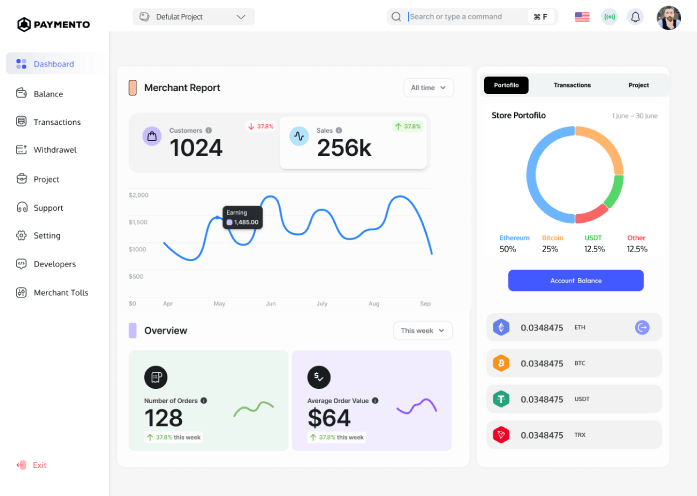
Non-custodial gateways like Paymento route payments directly into your own wallet. Your wallet is the destination from the moment an invoice is created. The gateway monitors the blockchain for payment confirmation but never touches your funds.
With Paymento:
- Funds arrive in your wallet at blockchain confirmation
- No withdrawal step. There’s nothing to withdraw from
- No entity can freeze your ability to receive payments
- Paymento charges 0.5% per transaction with no setup fee, no monthly cost, no reserve requirement
Getting Payment Processing Back Online
If your Stripe account was just banned, the priority is restoring revenue. Here’s the fastest path.
Payment links (same day)
Paymento’s payment links require no technical integration. Create an account, generate a payment link for any amount, and share it with customers. They pay with Bitcoin, USDT, Ethereum, Solana, Litecoin, or USDC. Working within hours.
WooCommerce plugin (under 30 minutes)
If you run a WooCommerce store, install the Paymento plugin, connect your wallet address, and crypto appears as a checkout option.
WHMCS module (for hosting businesses)
For hosting operators running WHMCS billing, the Paymento WHMCS module integrates with your invoicing workflow automatically.
API integration (for custom builds)
If you have development resources, Paymento’s REST API supports fully embedded custom checkout flows. Full documentation in the Paymento developer docs.
Your first $3,000 in processed payments is free.
What Crypto Payments Don’t Fix
Before switching, understand what stays the same.
Refunds require manual action. Crypto transactions are irreversible. If a customer is owed a refund, you send it from your own wallet. There is no automated dispute resolution. Build your refund policy and process before going live.
Stablecoin acceptance eliminates volatility. If you accept Bitcoin or Ether, the USD value of that payment can change between receipt and conversion. Accepting USDT or USDC eliminates this. They are pegged to USD. Paymento prices invoices in USD and handles conversion at checkout.
Not all customers have wallets. Crypto works where your customer base is crypto-familiar or willing to set up a wallet. It works well for web hosting customers, gaming customers, digital product buyers, and tech-tool users. It won’t immediately replace card coverage for customers who won’t engage with crypto.
Your compliance obligations don’t change. Non-custodial architecture means Paymento does not impose KYC on your customers. Your obligations as a merchant depend on your jurisdiction, business type, and what you’re selling. Non-custodial infrastructure does not mean your compliance exposure disappeared.
The Longer-Term Decision
Most merchants who come to crypto payments after a Stripe ban end up running crypto alongside a high-risk card processor rather than replacing cards entirely. This is often the right call.
Cards have broader customer adoption. Crypto eliminates chargebacks. Running both reduces exposure: crypto handles the segments most vulnerable to chargebacks (international customers, digital product buyers, crypto-native customers), while cards handle everyone else.
If your chargeback rate was the trigger, shifting even 20-30% of transactions to crypto can bring your card chargeback rate below the threshold that caused the ban, making it possible to maintain a card relationship alongside crypto.
You don’t have to choose one or the other. You have to choose what removes your single point of failure.