How to Accept USDT Payments as a Merchant (Without the Volatility Problem)
The biggest objection merchants have to accepting crypto is straightforward: “What if the price drops between when the customer pays and when I convert?”
It is a fair concern when you are talking about Bitcoin. But it is the wrong concern if you are accepting USDT.
USDT (Tether) is a stablecoin pegged to the US dollar. When a customer pays you 100 USDT, you receive 100 USDT. The price does not change by the time the transaction confirms. The volatility problem does not apply.
This post explains why USDT is the practical starting point for most merchants considering crypto payments, and how to accept it without any technical overhead.
Why Merchants Overestimate the Volatility Risk
The mental model most merchants carry goes like this: accept crypto, customer pays some fraction of a Bitcoin, price drops before you can convert, you absorb the loss.
That model made sense in 2017. It does not describe most merchant crypto payment flows today.
Stablecoins (USDT and USDC) account for the majority of crypto transactions in e-commerce. Customers in markets where banking access is limited, where international wire transfers are expensive, or where dollars are hard to hold in a local account are already holding USDT. They are not converting from another asset. They are paying with what they have.
Accepting USDT means:
- You set prices in USD or EUR, as you do now
- The customer pays the USDT equivalent at checkout
- You receive USDT in your own wallet
- Your revenue is stable in value
The volatility problem disappears. The friction of setting it up is what remains, and that is what this post covers.
Which Network Should You Accept USDT On?
USDT runs on multiple blockchains, and the network you accept affects transaction costs, confirmation speed, and which customers can pay you.
Solana (USDT-SPL): Best for speed and cost
Solana is currently the most practical network for USDT merchant payments. Transaction fees are consistently low, typically a fraction of a cent, and confirmations arrive in seconds. If you are setting up USDT payments for the first time and do not have a reason to prefer another network, Solana is the right starting point.
Ethereum (USDT-ERC20)
Ethereum is well-established and widely held. Transaction fees have come down significantly from their 2021 peaks, and for many use cases Ethereum now matches or undercuts other networks on cost. It reaches customers who hold assets across DeFi and established wallets. Worth enabling alongside Solana.
Tron (USDT-TRC20)
Tron was the default recommendation for USDT payments for several years due to its low fees. Network costs have risen considerably since then, and it no longer holds the clear cost advantage it once had. USDT-TRC20 still has a wide user base in certain regions, so it is worth keeping available, but it should not be your lead network recommendation today.
Coming soon: Polygon and BSC (BNB Chain)
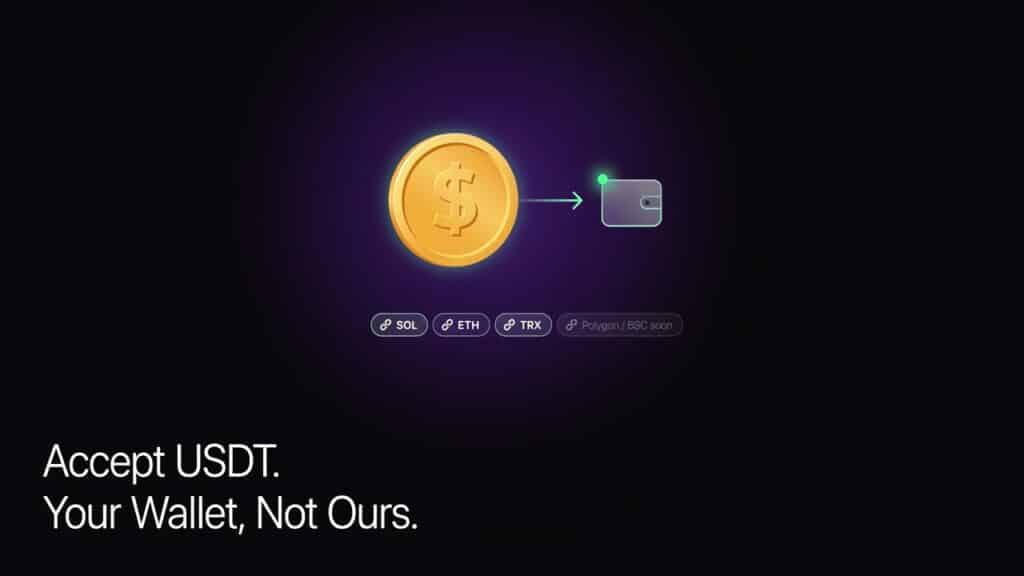
Paymento plans to add support for USDT on Polygon and BNB Chain (BEP-20). Both networks have low transaction costs and a large user base, particularly in Southeast Asia and emerging markets. This will give merchants more coverage without requiring any changes to their integration.
Paymento supports all current networks in a single integration. You enable each network independently from your dashboard, and customers see only the ones you have switched on.
How USDT Pricing Works at Checkout
With Paymento, you never price anything in crypto directly. Prices stay in your base currency: USD, EUR, or whatever you use today.
When a customer reaches checkout and selects USDT as their payment method, Paymento calculates the USDT equivalent in real time. For USDT this is effectively 1:1 with USD. The customer sees the amount, sends it from their wallet, and the payment confirms.
No conversion rate exposure. No manual calculation. No rounding errors.
Settlement speed depends on the network used. Solana confirms in seconds. Ethereum typically confirms within a few minutes under normal conditions. Set accurate expectations in your checkout copy. Do not promise instant settlement, because confirmation times vary with network load.
Where Your USDT Goes: Your Wallet, Not Ours
This is the part that sets Paymento apart from most crypto payment processors.
The typical custodial processor workflow: the customer pays, the processor credits your internal balance, and you withdraw on a schedule with possible delays, withdrawal limits, and identity checks. The processor holds your money.
Paymento does not hold your funds.
When a customer pays in USDT, the payment goes directly to your wallet address. Paymento creates the invoice, monitors the blockchain for the incoming transaction, sends you webhook notifications when the payment state changes, and keeps a complete transaction log. But the USDT moves from the customer’s wallet to your wallet. Paymento never has access to it.
No withdrawal step. No internal balance to manage. No exposure to Paymento as a counterparty.
And there are no chargebacks.
Blockchain transactions are irreversible. Once a USDT payment confirms, it is final. The customer cannot dispute it through their bank or card issuer. There is no chargeback mechanism at the protocol level.
For digital product sellers, this changes the math significantly. Digital goods (software licenses, downloads, templates, game keys, course access) are the highest-risk category for card chargebacks because there is no physical delivery to prove. Merchants frequently lose disputes. Switching those customers to USDT payments removes the dispute pathway entirely.
Setting Up USDT Payments for Your Store
There are three ways to accept USDT with Paymento. Which one fits depends on how your store is built.
WooCommerce
Install the Paymento WooCommerce plugin. USDT appears as a payment method at checkout alongside your existing options. Invoice creation, payment monitoring, and order status updates are all handled by the plugin. Customers who want to pay in USDT select it at checkout. Everyone else pays however they normally would.
WHMCS
If your business runs on WHMCS (common in web hosting, VPS, domain registration, and other recurring billing contexts) the Paymento WHMCS module integrates directly. Customers can pay invoices and renewals in USDT from within your client area.
Payment Links and Hosted Checkout
If you do not run a platform, or you accept payments for invoices, services, or one-off products, Paymento’s hosted checkout and payment link tools require no code. Create an invoice in the dashboard, share the link, the customer pays. This is also the fastest way to test USDT payments before integrating with your storefront.
In all cases, you configure the wallet address where funds arrive. There is no Paymento wallet involved.
Who Is Actually Paying in USDT?
A reasonable question: are there customers in your market who would pay in USDT?
For most merchants, the answer is yes. They tend to be a specific segment: customers in markets where international card payments are expensive, unreliable, or unavailable. Latin America, Southeast Asia, the Middle East, Eastern Europe. Markets where USDT is used as a practical dollar substitute because local currency options are unstable or banking access is limited.
If your business has any international reach (and most digital product businesses and hosting providers do), some portion of your customers are in these markets. They may be abandoning checkout today because the payment options do not work for them.
Adding USDT does not require removing anything. It is an additional option alongside your existing methods.
What USDT Payments Cost
Paymento charges a 0.5% fee on transactions. There are no monthly fees and no minimum volumes.
By comparison, card processing rates for international transactions typically run between 2.5% and 4%, plus chargeback fees when disputes occur. For merchants with recurring international revenue, the fee difference compounds quickly. The chargeback exposure is removed entirely.
Getting Started
If you sell digital products, run a hosting business, or accept payments for any service where chargebacks are a recurring cost, USDT payments are a practical addition to your checkout.
The integration is straightforward. Settlement goes directly to your wallet. The volatility concern does not apply to stablecoins.
Create an account and start accepting USDT on your store in three easy steps! Connect your wallet with your store, install the plugin or use a payment link, and your first USDT checkout is live within the hour.