What Is a Crypto Merchant Account? (And Why Non-Custodial Payments Don’t Need One)
Merchants who search for a crypto merchant account are usually asking a very specific question: my card processing is gone, or it costs too much, so what is the crypto version of the thing I lost?
It is a fair question with an awkward answer. The crypto version is not a version of the same thing. A merchant account is a specific financial arrangement with specific failure modes, and the reason crypto payments are worth considering is precisely that most of that arrangement does not exist.
That distinction matters, because half the crypto payment providers on the market rebuilt the merchant account anyway.
What a merchant account actually is
A merchant account is not a bank account. It is a line of credit.
When a customer pays you by card, the money does not move from them to you. The issuing bank extends credit, the acquiring bank advances you the funds, and the acquirer carries the risk that the transaction gets reversed later. You are not the acquirer’s customer so much as their credit exposure.
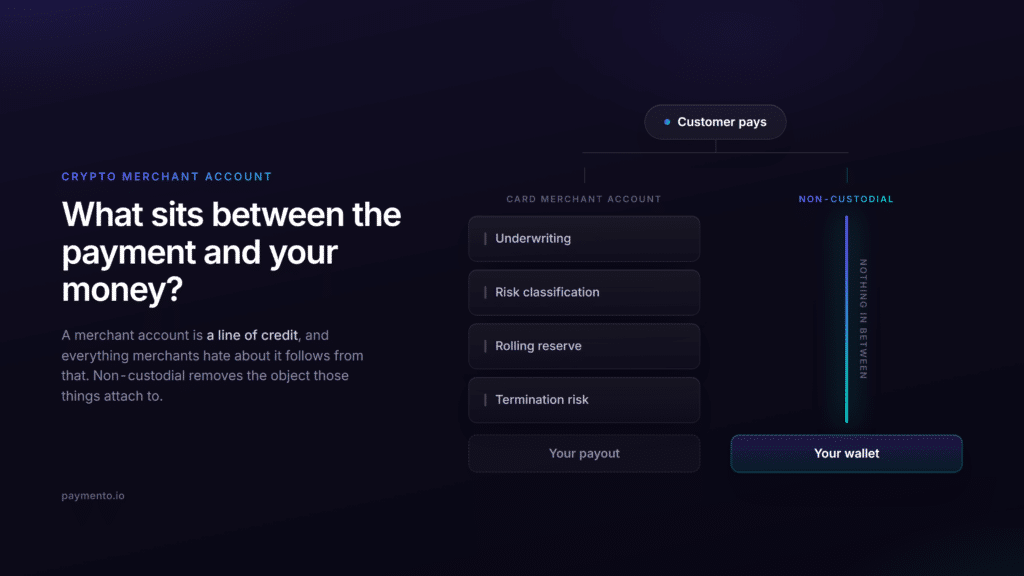
Four things follow from that, and all four are the things merchants complain about:
Underwriting. Before you can accept a card, someone assesses how likely you are to cost them money. That assessment looks at your industry, your refund history, your average ticket size, your delivery timeline, and how long you have been trading. Businesses that sell digital goods delivered instantly, or subscriptions, or anything with a cross-border customer base, score badly.
Reserves. If the acquirer decides you are a risk worth taking at a price, the price often includes holding some of your money. A rolling reserve of 5% to 10%, released after 90 to 180 days, is standard for high-risk accounts. That is your revenue, in their account, working for them.
Risk classification. Every merchant gets a category code, and the code follows you. It sets your rate, your reserve, and whether a new acquirer will take your call after the old one drops you.
Termination. Acquirers can end the relationship with very little notice, and terminated merchants can end up in industry databases that other acquirers consult during underwriting. One bad chargeback quarter can make you effectively unbankable for years.
None of this is malice. It is a rational response to the fact that the acquirer is holding the risk. Which is also the clue to why crypto behaves differently.
Why chargebacks are the root of all of it
Card chargebacks are not a courtesy. They are a legal right.
In the United States, Regulation Z gives cardholders a formal billing error resolution process covering goods that were not delivered, not accepted, or not delivered as agreed, and it does not require the cardholder to contact the merchant first (CFPB, Regulation Z § 1026.13). Similar consumer protections exist in most major markets.
That right is good for consumers. But it means every card transaction stays reversible for months, and somebody has to carry that exposure. The acquirer carries it, so the acquirer underwrites you, prices you, holds your reserve, and fires you when the math turns.
Underwriting, reserves and terminations are not the disease. Reversibility is. Everything else is the immune response.
So what does “crypto merchant account” mean in practice?
Two very different things, depending on the provider.
Custodial crypto processors take the customer’s crypto into their own wallets, hold it, and pay you out later. They have rebuilt the machine. Because they hold your funds, they now carry exposure, so they underwrite you, they apply their own risk tiers, they set withdrawal minimums and payout schedules, and they can freeze a balance while they review your account. You have a merchant account again. It just settles in USDT.
Non-custodial infrastructure does not hold the money at any point. The customer pays, the funds land in a wallet you control, and the provider’s role ends at generating the payment request and confirming it on-chain.
There is no account holding your balance, because there is no balance to hold. That is the entire difference, and it is architectural rather than a matter of policy or goodwill.
Paymento is the second kind. Settlement is wallet-to-wallet, on confirmation, and Paymento never takes custody of merchant funds.
What disappears when nobody holds your funds
Work through the four failure modes above.
No underwriting of your risk profile, because Paymento is not advancing you money it might not get back. Paymento does apply proportionate safeguards based on usage and risk, and it has an acceptable use position like any serious infrastructure provider. What it does not do is price you by industry category or decide whether your business model is creditworthy.
No reserve, because there is nothing to reserve against. Funds settle to your wallet. There is no pooled Paymento wallet sitting between the customer’s payment and your balance.
No card-network risk scoring, because the card networks are not involved.
No termination that strands your money. This is the one worth sitting with. If Paymento ever stopped serving your business, you would lose gateway access. You would not lose funds, because Paymento cannot freeze or seize what it never holds. Access and custody are separate, and most merchants have only ever dealt with providers where they are the same thing.
Paymento also does not require merchant KYC to open an account, because it never holds your funds, which is covered in more detail on our crypto payment gateway without KYC page. Your own regulatory and tax obligations in your jurisdiction are entirely unchanged by that.
The arithmetic, on a real-sized business
Take a hosting company doing $50,000 a month, classified high-risk, on typical high-risk acquiring terms: 11% all-in, plus a 10% rolling reserve released at 180 days.
That is $5,500 a month in processing fees. The reserve accrues at $5,000 a month and plateaus around $30,000 of your own working capital sitting in someone else’s account on a rolling basis.
The same $50,000 through Paymento at 0.5% is $250 a month, with no reserve. On an embedded wallet store the fee is 0.5% plus $0.20 per transaction, and you pay the blockchain network fee when you consolidate funds to your registered address. The full breakdown is on our fees and pricing page.
Those high-risk terms are typical, not universal, and your quote will differ. The structural point survives either way: one model prices your risk and holds your capital, the other charges for a service and holds nothing.
What does not disappear
A post that stopped there would be selling you something.
Your compliance obligations are unchanged. Sales tax, VAT, income reporting, sanctions screening, licensing in your jurisdiction. Not requiring KYC to open a Paymento account says nothing about what your own business is required to do. Blockchain transactions are also public and permanently recorded, which is worth understanding before anyone tells you crypto payments are private.
Irreversibility cuts both ways. No chargebacks means no chargeback fraud, and it also means no mechanism to claw back a payment you sent in error. Refunds become a deliberate act you perform, not a dispute someone files against you.
You inherit the trust burden. Card customers are protected by the reversibility described above. Crypto customers are not. If your checkout is confusing or your delivery is slow, there is no issuing bank to absorb the complaint. Clear terms and fast fulfilment stop being nice-to-haves.
Settlement follows network confirmation. Wallet-to-wallet settlement happens on confirmation, and confirmation times vary by chain. It is generally far faster than a 180-day reserve release, but it is not instant and nobody should tell you it is.
Crypto will not be 100% of your revenue. Most merchants run it alongside whatever card processing they still have, or as the only option in categories where cards were never available.
Which merchants this actually changes something for
If your card processing is working, priced normally, and nobody is holding your money, this is an optimization at best.
The merchants for whom the distinction is load-bearing are the ones where the card system has already made its decision: web hosting and server businesses, game servers and gaming, eSIM providers, digital subscription services, SaaS with an international customer base, and freelancers and agencies invoicing across borders where the receiving side of the banking system is the problem.
For those businesses, non-custodial is not a philosophical preference. It is the reason there is an option at all. The exposure that makes them unbankable is exposure a processor takes on by holding funds, and Paymento does not hold funds.
What setup actually looks like
There is no application and no underwriting queue.
- Create a store and choose how funds are held: connect your own wallet, generate a seed phrase wallet, or use an embedded wallet store with no wallet connection required at checkout on supported networks.
- Pick your chains. Bitcoin, Ethereum, Tron, Solana, Litecoin and Dogecoin are supported, along with USDT on Ethereum and Tron and USDC on Solana.
- Connect your store. WooCommerce, WHMCS and OpenCart have integrations. Hosted checkout and payment links work with no development at all.
- Price in USD or EUR. Paymento converts at checkout so you are not quoting customers in satoshis.
If you would rather run the payment server yourself, that is a legitimate choice with a different set of tradeoffs, and we covered it honestly in our comparison of BTCPay Server alternatives.
Start accepting crypto
If you have been searching for a crypto merchant account, what you are likely to actually want is the absence of one: no underwriting, no reserve, no category code, and no provider standing between a completed payment and your wallet.
Every new merchant starts with $15 in free credit, which Paymento fees draw from until it is used up. At the 0.5% rate on a bring-your-own-wallet store, that covers roughly your first $3,000 in payments. On an embedded wallet store the per-transaction fee draws on the same credit, so the covered volume is lower, and the blockchain network fee at settlement is always paid by you.
Create your Paymento store and start accepting crypto directly into a wallet you control.