How to Accept Crypto Donations Without a Platform Holding the Funds
The moment a fundraiser starts working is the moment it gets reviewed.
Anyone who has run a campaign that went further than expected knows the pattern. Donations come in faster than normal, the platform flags the account, and the money sits while someone decides whether you are legitimate. You are not accused of anything. You just cannot access the funds, and the people who gave them cannot tell whether their money arrived.
That is not a customer service failure. It is what custody is for.
Why donation platforms hold the money
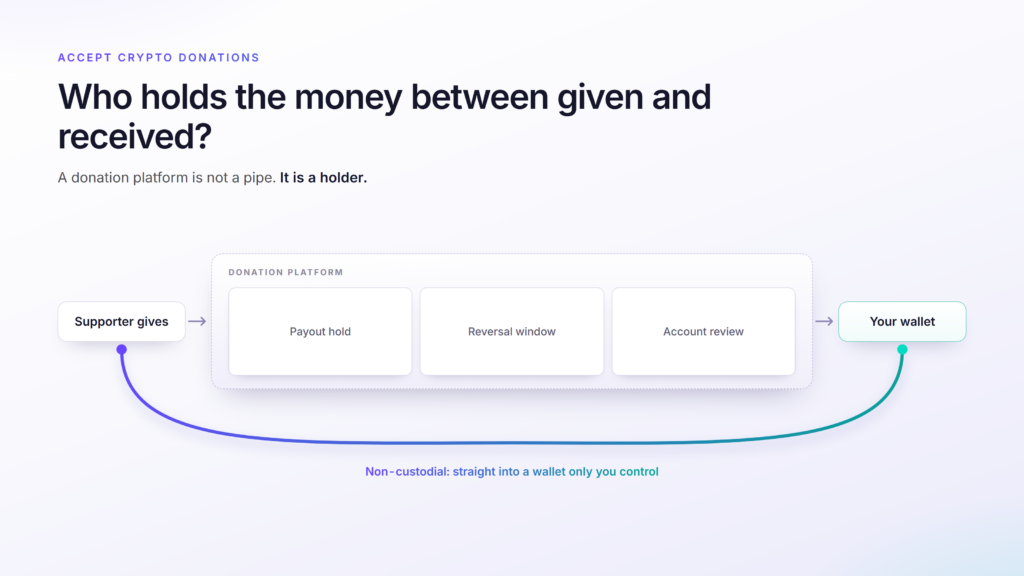
A donation platform is not a pipe. It is a holder.
When someone donates by card, the platform receives the money into its own account first, then passes it to you on its own schedule. For as long as it holds those funds, it carries every risk attached to them: the donor’s bank can reverse the charge, the card networks can penalise the platform for the reversal rate, and the platform’s own banking partner can ask uncomfortable questions about who it is moving money for.
Holding creates exposure. Exposure creates rules. So the platform reviews accounts, holds payouts, sets thresholds, and removes organisations whose subject matter makes its bank nervous.
Three specific things follow, and they are the three things people actually complain about:
Payout delays. Funds sit for days or weeks, often longest exactly when volume spikes, because a volume spike is what triggers review.
Reversals. Card donations stay reversible for months. A donor can dispute, or a stolen card can be used to donate and then charged back, and the platform claws the money back from you after you have already spent it on the thing you raised it for.
Deplatforming. The account can be closed. For a cause that depends on a single donation page, that is not an inconvenience, it is the end of the fundraiser.
What changes when nobody holds the money
Crypto donations are a direct transfer. The donor sends, and the funds arrive in a wallet you control. There is no intermediate account, so there is no intermediate holder deciding when you get access.
That removes the three problems above at the root rather than mitigating them:
- No payout schedule, because there is no payout. The donation is already yours when it confirms on-chain.
- No reversals. Blockchain transactions are irreversible. Nobody can claw back a donation after the fact.
- No account to close. If a provider stopped serving you, you would lose the checkout tooling, not the funds. Paymento cannot freeze or seize what it never holds.
Paymento is non-custodial infrastructure. Settlement is wallet-to-wallet on confirmation, and Paymento never takes custody of the money. It also does not require merchant KYC to open an account, because it never holds your funds, which is covered on our crypto payment gateway without KYC page.
Donation button, payment link, or a raw wallet address
There are three ways to actually collect, and they are not equally good.
A raw wallet address is the tempting one, because it costs nothing. Post an address, ask for donations. The problems show up immediately: you cannot tell who sent what, you get no record beyond the chain itself, donors on the wrong network lose their money, and a single copy-paste error on your side sends every future donation to an address you do not own. Plenty of projects have done exactly that.
A payment link is a shareable URL that opens a checkout page. You can create links for set amounts, so a supporter picks “$25” rather than working out what that is in ETH today. The link goes in a newsletter, a video description, a README, a pinned post, or behind a Donate button on your own site. This is the practical default for most people. See how payment links work.
Hosted checkout is the same page, reached from your own site, when you want the flow to start somewhere you control.
Whichever you use, price in fiat. A donor who wants to give twenty dollars should be asked for twenty dollars, not for 0.00018 BTC. Paymento converts at checkout.
The transparency tradeoff, stated honestly
This is where most articles on crypto donations are dishonest, so it is worth being direct.
On-chain donations are public. Every transaction to your address is permanently recorded and visible to anyone. There is no version of this where donations are private.
For some organisations that is a genuine feature. A transparency page showing exactly what came in and where it went is more credible than an annual report, and it is verifiable by anyone without trusting you. Open source projects and public-good funding have used this well.
For others it is a real problem. If your donors have reasons not to be publicly associated with your cause, a public ledger is the wrong tool and you should think carefully before pointing them at it. Nothing about crypto makes a donation anonymous. An address is not a name, but addresses are routinely linked to identities, and telling donors otherwise would be misleading them about their own risk.
Decide which of those two situations you are in before you publish an address anywhere.
What does not disappear
Your tax and reporting obligations are unchanged. In the United States the IRS treats virtual currency as property rather than currency for federal income tax purposes (IRS, Frequently Asked Questions on Virtual Currency Transactions). For a registered charity that affects how gifts are valued, receipted and substantiated, and the thresholds are not the same as for cash. Rules differ by country. Talk to an accountant who has handled this before, not to a forum.
Irreversibility protects you and exposes your donors. No chargebacks means no chargeback fraud against your campaign. It also means a supporter who sends to the wrong address or the wrong network has no recourse, and no support team can undo it for them. Make the network obvious at the point of donation.
Volatility is real if you hold. A donation received in a volatile asset is worth whatever it is worth when you convert it. Stablecoins avoid that specific problem, which is why USDT and USDC are the sensible default for anyone raising toward a fixed budget.
Your own obligations are unchanged by Paymento’s onboarding. Not being asked for identity documents says nothing about charity registration, reporting or tax in your jurisdiction.
Crypto will not replace your card donations. For most organisations it is an additional channel that works when the main one is unavailable or slow, not a replacement for it.
Who this actually suits
Not everyone. If your donations are modest, your platform pays out reliably, and your cause is uncontroversial to a bank, the existing setup is fine and this is extra work.
It matters when one of these is true:
- Your donors are international and card donations from their country get declined or arrive after heavy fees.
- Your cause is one that payment platforms review, and you have already had a payout held or an account questioned.
- Your project is online-native, like an open source maintainer, a researcher or an independent creator, where supporters already hold crypto and asking for it costs you nothing.
- You want verifiable transparency, and a public record of funds in and out is an asset rather than a liability.
The common thread is not the cause. It is whether something currently sits between a supporter’s decision to give and your ability to use the money.
Setting it up
- Create a store and choose how funds are held: connect your own wallet, generate a seed phrase wallet, or use an embedded wallet store that needs no wallet connection at checkout on supported networks.
- Pick your chains. Bitcoin, Ethereum, Tron, Solana, Litecoin and Dogecoin are supported, along with USDT on Ethereum and Tron and USDC on Solana. If you are raising toward a budget, lead with the stablecoins.
- Create payment links for a few set amounts, and put them behind Donate buttons on your site, in your newsletter and in your project README.
- Price in USD or EUR so supporters give in a number they recognise.
- If transparency is part of your pitch, publish the receiving address and let anyone verify the total themselves.
Start accepting donations
If a platform is holding your fundraiser’s money, the fix is not a better platform. It is not having one in the middle.
Paymento charges 0.5% per transaction, and every new account starts with $15 in free credit that fees draw from until it is used up. On an embedded wallet store there is an additional $0.20 per transaction, and you pay the blockchain network fee when you consolidate funds to your registered address. Full detail is on the fees and pricing page.
Create your Paymento store and take donations directly into a wallet you control.