Anonymous Crypto Payment Gateway: How to Accept Payments Without Collecting Customer Data
Most payment gateways, crypto or traditional, are built around data collection. Name, email address, IP address, sometimes full identity verification. The assumption baked into the infrastructure is that payments require personal information to function.
But a growing segment of customers specifically chooses crypto because they don’t want to hand over personal data every time they buy something. They’re not doing anything illegal. They’re privacy-conscious, crypto-native users who see data minimization as a feature, not an inconvenience.
If your payment gateway forces them to submit an email address just to pay you, you’re creating friction that directly contradicts why they chose crypto in the first place and you’re losing sales as a result.
Paymento recently made a product decision that reflects this reality: email collection from payers is now optional. A customer can complete a crypto payment on Paymento without submitting any personal information at all. This guide explains what that means, who it matters for, and how to set it up.
Why Some Customers Demand Anonymous Payments
Privacy in payments isn’t a fringe concern. It’s a mainstream preference that’s growing as data breaches become routine, advertising surveillance becomes more visible, and customers become more deliberate about where their personal information ends up.
The customers who specifically seek out anonymous payment options tend to share a few characteristics. They’re technically informed they understand that handing over an email address starts a data trail. They’ve chosen crypto partly because of its pseudonymous nature. And they’re often high-value customers: VPN subscribers, privacy software users, security researchers, digital product buyers, and international shoppers who’ve had bad experiences with data-hungry Western payment processors.
Concretely, this includes:
VPN and privacy software customers who are, almost by definition, people who care about their digital footprint. Requiring an email to purchase a VPN subscription is a jarring contradiction that many providers have already moved away from.
Digital content buyers across a range of categories particularly in markets where credit card payments are stigmatized or where content is region-restricted and customers use crypto specifically to avoid geographic profiling.
International buyers in regions with limited banking access or unstable currencies who use USDT as a practical payment rail and have no interest in creating accounts or providing personal details to foreign merchants.
Crypto-native customers who operate largely pseudonymously across the web and prefer to keep their purchase history disconnected from their identity.
Businesses buying B2B services who prefer not to leave a data trail with every software vendor they evaluate.
None of these use cases involve anything illegal. They’re ordinary commercial transactions where the customer’s preference is simply not to share personal data unnecessarily.
What “Anonymous” Actually Means in Crypto Payments
Before going further, it’s worth being precise about terminology, because “anonymous” means different things at different layers of a payment.
Blockchain transactions are pseudonymous, not anonymous. Every transaction on a public blockchain, Ethereum, Tron, Solana, BNB Chain is permanently recorded and publicly visible. The wallet addresses involved, the amount, the timestamp: all of this is on-chain data that anyone can view. What’s not attached to that data, by default, is a real-world identity. A wallet address is a string of characters, not a name.
What a gateway collects is a separate question from what the blockchain records. A gateway can record your customer’s email address, IP address, browser fingerprint, and device ID, none of which appears on the blockchain. This is the layer where data minimization actually matters for merchants. The blockchain will always record that a wallet sent an amount to an address. Whether that wallet is connected to a named person depends on what the gateway and merchant collect and store.
What Paymento’s optional email feature changes is the off-chain data layer. When email is required, the gateway links an email address to a transaction creating a connection between a real-world identity and an on-chain wallet address. When email is optional and a customer chooses not to provide it, that link is never created. The transaction completes. The merchant receives payment. No personal data changes hands.
This is distinct from privacy coins like Monero, which obscure the on-chain transaction itself. Paymento works with transparent blockchains — what’s being minimized is the data collected around the transaction, not the transaction’s on-chain visibility.
How Most Crypto Gateways Handle Customer Data (And Why It’s a Problem)
The standard checkout flow for most crypto payment gateways looks like this: customer initiates payment, gateway prompts for email address, customer submits email, payment address is generated, transaction completes, confirmation email is sent.
The email is framed as a convenience, a receipt, a confirmation, a way to follow up if something goes wrong. And for many customers, that’s fine. But requiring it creates two problems.
First, it’s friction. Every additional field at checkout reduces conversion. For customers who are philosophically opposed to handing over their email to yet another platform or who are using a privacy-focused email alias they’d rather not expose, the mandatory email field is a small but real reason to abandon the transaction.
Second, it creates a data liability. Every email address you collect is personal data you’re now responsible for storing, protecting, and potentially disclosing in the event of a legal request or data breach. For merchants who serve privacy-conscious customers, the question isn’t just “do we need this data?” but “do we want the liability that comes with holding it?”
Custodial gateways go further. Many require payers to complete identity verification before a payment can be processed, the same KYC process that exchanges use. For a merchant selling a $30 software license, asking the buyer to submit a government ID is obviously not appropriate. But some custodial architectures effectively require it because the gateway is acting as a financial intermediary, which triggers regulatory obligations.
The result is that merchants using custodial gateways are often forced to impose data collection requirements on their customers that they didn’t choose and can’t remove.
Paymento’s Optional Email Feature: What Changed and Why It Matters
Previously, Paymento required a payer email address to initiate a payment. The email served as the primary notification channel, confirmation of payment, link to the transaction record, updates on confirmation status.
The updated flow makes email completely optional. Here’s what changes in practice:
For payers who skip the email field: The payment address is generated, the transaction proceeds, on-chain confirmation is detected, and the order is fulfilled exactly as before. The only difference is that no confirmation email is sent, and no email address is stored. The payer’s identity, from Paymento’s perspective, is their wallet address and nothing else.
For payers who provide an email: Nothing changes. They receive confirmation as before. The option to provide an email is preserved for customers who want a receipt or notification.
For merchants: The transaction record in your dashboard shows everything you need — transaction hash, amount, chain, wallet address, timestamp. Order fulfillment triggers normally. What you don’t receive is a payer email that you didn’t ask for and may not need.
This is a deliberate product choice, not a technical limitation. Paymento made email optional because the business case for requiring it, confirmation emails, doesn’t justify the friction and data liability it creates for merchants serving privacy-conscious customers.
Is Anonymous Crypto Acceptance Legal? The Compliance Reality
This is the question most merchants ask first, and the answer requires some nuance.
KYC and AML obligations apply to custodians and financial intermediaries. The regulatory frameworks that require identity verification — Know Your Customer, Anti-Money Laundering — were designed for entities that hold, transfer, or intermediate funds on behalf of others. Banks, exchanges, payment processors that hold merchant funds: these are the entities that KYC requirements target.
Non-custodial merchants are in a different legal category. When you accept crypto directly to your own wallet via a non-custodial gateway like Paymento, you’re receiving payment for goods or services — the same as accepting cash or a bank transfer. The gateway never holds funds. There’s no financial intermediary in the transaction. The legal treatment is closer to “merchant accepting payment” than “financial institution processing a transfer.”
This means that, for most non-custodial merchants selling ordinary goods and services, there’s no legal requirement to collect identity information from payers. You’re not a money services business. You’re a merchant.
That said, there are important exceptions:
Regulated industries have their own requirements regardless of payment method. If you’re selling financial products, gambling services, or anything else that triggers sector-specific regulation in your jurisdiction, those rules apply regardless of how you accept payment.
High-value transactions may cross thresholds that trigger reporting requirements in some jurisdictions, even for non-custodial merchants.
Geography matters. The regulatory picture varies significantly by country. What’s permissible for a merchant in one jurisdiction may be restricted in another.
The practical guidance: For merchants selling digital products, SaaS, content, hosting, or similar services, accepting crypto without collecting payer identity information is generally legal. For regulated industries or high-value transactions, consult with a legal or compliance advisor familiar with crypto in your specific jurisdiction before removing data collection requirements.
Which Business Types Benefit Most from Anonymous Payment Acceptance
VPN and privacy tool providers are the clearest fit. The entire value proposition of these products is helping customers protect their privacy online. A payment flow that requires an email address before allowing someone to buy a VPN subscription is a contradiction that customers notice. Optional email removes that friction and aligns the payment experience with the product’s core promise.
Digital content platforms, particularly those in mature content categories or operating in multiple jurisdictions, have long dealt with customers who prefer anonymous transactions. Crypto without mandatory data collection gives them a legitimate payment rail that doesn’t require customers to create accounts or submit identifying information.
Security and privacy software vendors, password managers, encrypted communication tools, security researchers’ toolkits serve a customer base that is, by definition, more privacy-aware than average. Matching that customer expectation at checkout is a trust signal.
International SaaS businesses, serving markets where users are skeptical of Western platforms collecting their data benefit from offering a payment option that doesn’t require an account or email with a foreign company.
Peer-to-peer marketplaces and platforms where buyers and sellers interact pseudonymously can use Paymento’s anonymous payment flow to keep the payment layer consistent with the platform’s overall privacy model.
Subscription communities and Telegram groups where membership is pseudonymous, crypto trading signals, privacy forums, research communities can sell access via payment links without requiring members to expose their identity to complete a payment.
What You Still Know as a Merchant (It’s More Than You Think)
Anonymous payment acceptance doesn’t mean operating blind. Even without a payer email, you have meaningful transaction data:
Wallet address. Every payment comes from a wallet address. This is pseudonymous not tied to an identity by default but it’s consistent. A repeat customer using the same wallet address can be identified across transactions even without an email, enabling loyalty programs or repeat-customer treatment without requiring personal data.
Transaction hash. Every on-chain transaction has a unique hash that’s permanently recorded on the blockchain. This is your audit trail. If a dispute arises, the transaction hash is immutable proof of payment more reliable than an email receipt.
Amount, chain, and timestamp. Your dashboard records exactly what was paid, on which network, and when. Order fulfillment logic can trigger automatically based on this data without requiring any personal information.
On-chain history. For merchants who want to go deeper, a payer’s wallet address has a full public transaction history on the blockchain. This isn’t data you collect it’s data that’s publicly available by the nature of the blockchain.
For digital product delivery, the fulfillment trigger is payment confirmation not the customer’s email. A download link, license key, or access credential can be displayed at the payment confirmation screen or embedded in the payment success page, with no email required. The customer gets their product. You get paid. No data changes hands.
How to Set Up Anonymous Payment Acceptance with Paymento
Configuring Paymento for optional email collection takes about two minutes in the dashboard.
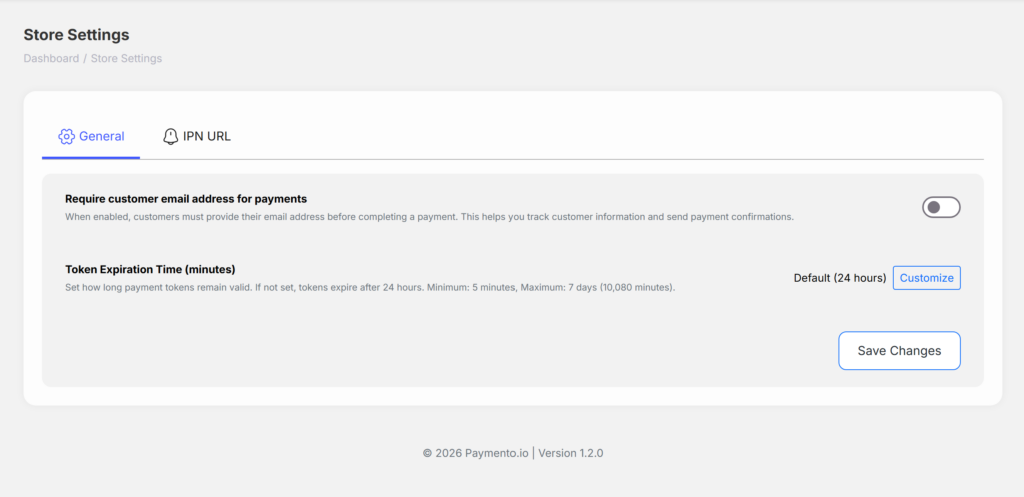
Step 1: Log into your Paymento dashboard Navigate to your store settings.
Step 2: Set Require customer email address for payment to optional. This change applies to all new payment sessions, existing payment links don’t need to be regenerated.
Step 3: Update your product delivery flow If your current fulfillment process relies on sending the product to the customer’s email, you’ll need to adjust for the case where no email is provided. The recommended approach for digital products is to display the download link or license key on the payment confirmation screen visible immediately after on-chain confirmation, no email needed.
For subscription or access-based products, trigger access based on wallet address or transaction hash rather than email. Paymento’s webhook sends full transaction data on confirmation, giving your system everything it needs to fulfill the order without email.
Step 4: Update your checkout copy Make it clear to customers that email is optional and explain why “Enter your email for a receipt, or leave blank to pay anonymously.” Customers who want a confirmation email can still provide one. Customers who prefer not to share their email have an explicit choice.
Step 5: Review your privacy policy If you’re committing to not collecting payer data, reflect that in your privacy policy. For privacy-conscious customers, a clear privacy policy that says “we don’t collect your email unless you choose to provide it” is a meaningful trust signal.
Frequently Asked Questions
Is accepting anonymous crypto payments legal? For most non-custodial merchants selling ordinary goods and services, yes. KYC and AML requirements apply to financial intermediaries and custodians, not to merchants receiving payment directly. That said, regulated industries and high-value transactions may have additional requirements depending on your jurisdiction. Consult a legal advisor for your specific situation.
Can I still track orders without collecting customer email? Yes. Paymento’s dashboard records every transaction with its wallet address, transaction hash, amount, chain, and timestamp. Order fulfillment can trigger automatically on payment confirmation without requiring an email. For digital products, deliver via the confirmation screen rather than email.
What if I need to issue a refund to an anonymous payer? Refunds work the same way as any crypto transaction, you send from your wallet to the payer’s wallet address. You have the wallet address from the transaction record even if you don’t have an email. The customer needs to claim the refund by providing their wallet address, which is standard for crypto refunds regardless of whether email was collected.
Does anonymous acceptance increase fraud risk? Not significantly for digital goods merchants. Crypto payments are irreversible by nature unlike credit cards, there are no chargebacks. The fraud pattern that anonymous acceptance theoretically enables purchasing with a stolen identity doesn’t apply when the payment method itself doesn’t require identity. The practical fraud risk for most digital goods merchants is very low.
Which cryptocurrencies are most private for anonymous payments? Among the coins Paymento supports, USDT and other stablecoins on transparent blockchains (Tron, Ethereum, Solana) offer pseudonymous but publicly auditable transactions. The optional email feature minimizes off-chain data collection, but the on-chain transaction remains visible. For merchants whose customers want maximum on-chain privacy, privacy coins like Monero offer transaction obfuscation at the blockchain level though these are a separate product category with their own tradeoffs and are not required for most anonymous payment use cases.
What’s the difference between anonymous and private payments? Anonymous payments, in the context of this article, refers to minimizing the personal data collected by the gateway and merchant, specifically, not requiring an email or identity from the payer. Private payments in a technical crypto sense typically refers to obfuscating the on-chain transaction itself, as privacy coins do. Paymento’s optional email feature addresses the first. Blockchain-level privacy requires different tooling.
The Core Idea
Privacy-conscious customers are a real and growing segment. They choose crypto specifically because it offers a way to transact without feeding their personal data into yet another platform’s database. If your checkout flow immediately asks them for an email or worse, full identity verification, you’ve negated the reason they chose crypto in the first place.
Making email optional isn’t just a feature. It’s an alignment between your payment infrastructure and your customers’ values. For businesses whose customers care about privacy, that alignment is a competitive advantage.
Paymento is one of the only crypto payment gateways where a customer can pay, receive their product, and complete the entire transaction without submitting any personal information. Non-custodial settlement means Paymento never holds funds. Optional email means no personal data is collected unless the customer chooses to provide it. The result is a payment experience that actually matches what privacy-focused customers came to crypto for.
Set up anonymous crypto payment acceptance with Paymento →
Questions about compliance, fulfillment flows, or configuring optional email? Contact our team or read the integration documentation.