Best Crypto Payment Gateways Without KYC (That Actually Work) — 2026 Update
Discover how to accept crypto payments without invasive identity checks or giving up custody of your funds and why most “crypto gateways” still get it wrong.
🔍 What Is KYC, and Why Most Crypto Gateways Still Require It
KYC (Know Your Customer) is a compliance process where platforms verify user identities using passports, driver’s licenses, or other documents. Custodial crypto payment processors like Coinbase Commerce, BitPay, or NOWPayments fall under this because they handle your funds — converting crypto, holding balances, or settling in fiat.
This makes them regulated financial entities, forcing them to implement KYC/AML protocols.
But here’s the real issue: KYC kills privacy, creates onboarding friction, and limits global access. Even if KYC is touted as “safe,” it creates headaches for merchants and customers alike.
- Delayed onboarding: Customers must verify their identity, upload documents, and wait for approval.
- Privacy invasion: Sensitive data is stored, increasing risks of data breaches.
- Censorship: Users from certain regions are banned or limited due to geopolitical restrictions.
- Trust issues: Holding customer funds (as custodial gateways do) introduces risk.
This friction goes against the core principles of crypto: privacy, freedom, and decentralization. Instead, consider a crypto payment gateway without KYC like Paymento, enable businesses to tap into a wider audience while respecting customer privacy.
🏦Why Non-Custodial ≠ Money Transmission
Most people confuse crypto payment gateways with money transmitters because custodial processors act like banks: they hold funds, control keys, convert assets, or settle payments on behalf of merchants. That activity legally qualifies as money transmission in many jurisdictions.
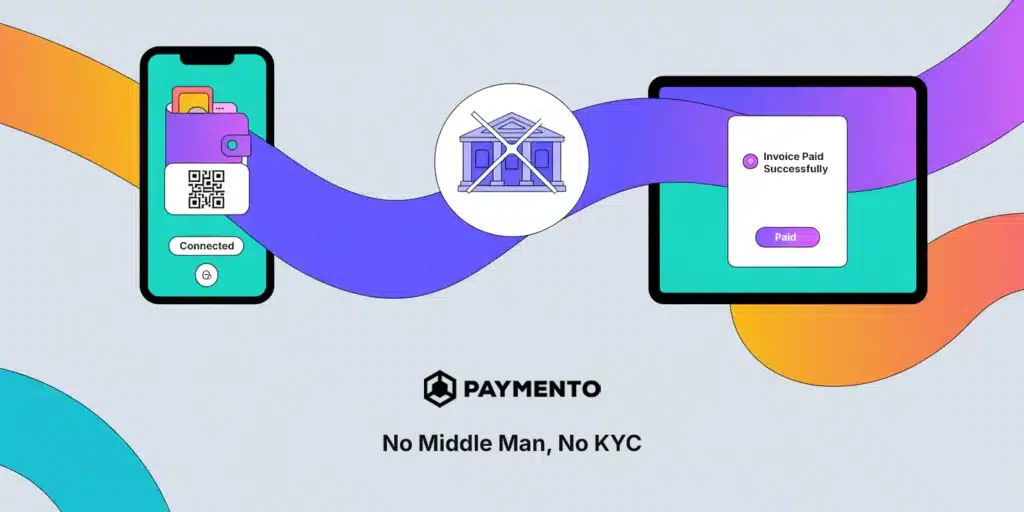
A non-custodial platform is fundamentally different. The provider never touches customer funds, never controls private keys, and never executes transactions on behalf of a merchant. Payments move directly from the payer’s wallet to the merchant’s wallet using on-chain settlement.
Because no third party takes possession of funds at any point, the activity does not fall under typical money service legislation, and therefore does not trigger MSB or money-transmitter licensing requirements.
When KYB Is (and Isn’t) Required
Non-custodial gateways generally do not require KYB because they do not hold customer funds or process fiat transactions. KYB becomes necessary only when a provider:
- stores or manages customer balances
- converts assets (crypto → fiat or crypto → crypto)
- executes payouts on behalf of merchants
- intermediates settlement in any form
If any of these actions happen, regulators typically treat the business like a financial intermediary, and KYB becomes mandatory. For purely wallet-to-wallet payments, where merchants receive funds directly to their own addresses, KYB is generally not required.
⚠️ Gateways That Claim No-KYC But Aren’t Fully Non-Custodial
This is something most comparison guides don’t tell you: several gateways that market themselves as “no-KYC” or even “non-custodial” are technically still custodial in their actual payment flow.
NOWPayments is the most prominent example. Their marketing uses non-custodial language, but the actual architecture works like this: when a customer initiates a payment, NOWPayments generates a temporary deposit address but that address belongs to NOWPayments, not to the merchant. The customer’s funds land in NOWPayments’ wallet first. NOWPayments then initiates a second transfer to forward the funds to the merchant’s wallet.
This matters for three concrete reasons:
First, merchants pay a hidden network fee. The forwarding transfer, from NOWPayments’ wallet to the merchant’s wallet is a separate on-chain transaction. That network fee is deducted from the merchant’s settlement amount. A merchant expecting to receive $100 USDT receives less, depending on the chain and current network conditions.
Second, the funds are legally in NOWPayments’ possession during the window between the customer paying and the forwarding transaction completing. If NOWPayments experiences technical issues, a regulatory action, or insolvency during that window, the merchant’s recourse is as an unsecured creditor — the same legal exposure as any custodial arrangement.
Third, the no-KYC claim is conditional, not absolute. NOWPayments applies identity verification requirements at higher transaction volumes. Merchants scaling their business will eventually hit verification thresholds — the “no-KYC” positioning applies only to smaller accounts.
A genuinely non-custodial gateway never generates a deposit address in its own wallet. The receiving address is derived directly from the merchant’s own wallet and exists there before any payment is made. No transfer from the gateway to the merchant ever occurs because the funds were never the gateway’s to transfer.
🛡️ Meet Self-Custody Crypto Gateways: The No-KYC Alternative
Enter Paymento, a non-custodial, self-custody crypto gateway where merchants retain full control of their funds and user identities are not required. With Paymento, you can accept anonymous crypto payments with no KYC, no middlemen, and no third-party fund custody.
Benefits of Using a Self-Custody Crypto Gateway:
✅ No KYC, Ever
Merchants and buyers transact directly, no documents, no waiting, no surveillance.
✅ Wallet-to-Wallet Payments
Funds go straight to your wallet. No one holds, converts, or freezes your crypto.
✅ True Privacy
No data collection, no logs, no risk. Your customers pay anonymously.
✅ Fast Setup
Launch in minutes, just connect your wallet and generate a payment link or QR code.
✅ Global, Permissionless Payments
Reach customers worldwide without compliance bottlenecks.
🚀 Why Paymento Is a True Anonymous Crypto Gateway
Most “no-KYC” services bend the truth. They might skip KYC for small transactions or basic accounts but still require verification at higher tiers.
Paymento is architecturally different. It is 100% non-custodial, meaning:
- It never takes possession of your funds at any point in the payment flow
- It never performs asset conversions on your behalf
- It never stores or controls private keys
- It has no ability to freeze, hold, or redirect your payments
Instead, it acts as coordination infrastructure between your store and your customer — providing:
- XPUB-based address generation for Bitcoin (unique address per transaction, directly in your wallet)
- Wallet address configuration for account-based chains (Ethereum, Tron, Solana)
- WooCommerce and WHMCS plugins for e-commerce and hosting billing
- Payment links and QR codes for creators and businesses without a website
- Telegram automation for community and subscription monetization
No intermediaries. No limits. No custody.
⚙️ How to Start Accepting Crypto Without KYC
Getting started with Paymento takes under 5 minutes:
- Create your account at app.paymento.io — no KYC, no document upload required
- Configure your wallet and store — enter your wallet address per chain, or your Bitcoin XPUB
- Get your API key from the dashboard
- Enable payments — via WooCommerce plugin, WHMCS plugin, payment link, QR code, or API
- Receive funds directly — instantly, on-chain, to your own wallet on every transaction
Paymento supports two primary ways to accept crypto payments:
Fully integrated gateway for websites Merchants running WooCommerce, WHMCS, or custom sites can install Paymento’s plugin or API to accept on-chain payments at checkout. Funds go straight to their own wallet — the entire flow is non-custodial from the first transaction.Payment links for businesses without a website Creators, coaches, Telegram group admins, and freelancers can generate a payment link or QR code from the dashboard and start accepting crypto immediately. No domain, no hosting, no coding required. Payment links support Telegram automation for paid group access, premium content, and recurring payment management.
🧠 Who Needs a No-KYC Crypto Payment Gateway?
No-KYC crypto payment gateways serve a wide range of legitimate business types:
Privacy-focused software businesses — VPN providers, security tools, and privacy services whose customers specifically expect minimal data collection. Requiring KYC at payment is a direct contradiction for businesses whose entire value proposition is privacy.
Hosting and infrastructure providers — WHMCS-based hosting businesses, VPS providers, and domain registrars serving international customers who pay in USDT or Bitcoin. The no-KYC flow removes friction for technical customers who already hold crypto.
Digital content creators and freelancers — Coaches, consultants, course creators, and subscription content producers accepting payments from global audiences without building compliance infrastructure.
Telegram community operators — Group admins monetizing paid communities, signals groups, research subscriptions, or premium content channels. Paymento’s Telegram automation handles membership access automatically on payment confirmation.
IPTV and streaming service providers — A segment with strong crypto payment demand and preference for minimal data collection from both merchants and customers.
Borderless SaaS businesses — Software companies serving customers across multiple countries who face friction with card processors due to international billing restrictions or high cross-border fees.
NGOs and donation-based organizations — Charities and non-profits accepting global crypto donations without requiring donors to undergo identity verification.
Crypto-native e-commerce — Stores whose customer base consists primarily of crypto holders who choose to pay in crypto for ideological, privacy, or practical reasons.
If your business values customer privacy, operates internationally, or serves a technically sophisticated audience, a custodial, KYC-heavy payment processor is the wrong infrastructure.
❌ Crypto Payment Gateways Without KYC: Full Comparison
Not all gateways that appear in “no-KYC” searches are equal. Here’s an honest comparison of the most commonly evaluated options in 2026:
| Feature | Paymento | NOWPayments | BTCPay Server | BitPay | Coinbase Commerce |
| Truly non-custodial | ✅ | ⚠️ Pseudo-custodial | ✅ | ❌ | ❌ |
| No merchant KYC | ✅ | ⚠️ Conditional | ✅ | ❌ | ❌ |
| No payer KYC | ✅ | ✅ | ✅ | ❌ | ⚠️ Sometimes |
| Direct wallet settlement | ✅ | ❌ Forwarded | ✅ | ❌ | ❌ |
| Hidden forwarding/withdrawal fee | ❌ None | ✅ Yes — deducted from settlement | ❌ None | ✅ Yes | ✅ Yes |
| USDT TRC-20 support | ✅ | ✅ | ❌ | ⚠️ Limited | ❌ |
| Multi-chain USDT | ✅ | ✅ | ❌ | ⚠️ | ❌ |
| WooCommerce plugin | ✅ | ✅ | ✅ | ✅ | ✅ |
| WHMCS plugin | ✅ | ✅ | ✅ | ❌ | ❌ |
| Self-hosted / requires own node | ❌ | ❌ | ✅ Required | ❌ | ❌ |
| Technical setup difficulty | Low | Low | High | Low | Low |
| Account freeze risk | ❌ None | ⚠️ Possible | ❌ None | ✅ Known issue | ✅ Known issue |
| Transaction fee | 0.5% | 0.4–0.5% | Free (self-hosted costs) | 1%+ | Free (withdrawal fees apply) |
What you need to know about each:
NOWPayments claims non-custodial status but funds pass through their wallet infrastructure before forwarding to merchants. This creates a hidden network fee on every settlement, a window of legal custody risk, and KYC requirements that kick in at higher volumes. The non-custodial marketing is misleading.
BTCPay Server is genuinely non-custodial and charges no platform fees — it’s open-source software you self-host. For the right technical team, it’s a solid option. The significant limitations: it requires running and maintaining your own server and Bitcoin node, demands meaningful technical expertise for setup and ongoing maintenance, and is primarily built for Bitcoin and Bitcoin-based chains. Multi-chain stablecoin support particularly USDT on TRC-20, ERC-20, and Solana is not supported. Not practical for most merchants without a dedicated technical team or DevOps capacity.
BitPay is fully custodial with mandatory KYC on both merchants and payers. The longest operational track record in the industry but the furthest from a no-KYC, non-custodial experience.
Coinbase Commerce is custodial and primarily oriented toward USDC on Base (Coinbase’s own L2 blockchain). Limited TRC-20 USDT support is a significant gap for merchants with international customers. Payer KYC is sometimes triggered depending on transaction parameters.
⚖️ Legal Considerations for No-KYC Payments
Using a self-custodial payment system doesn’t eliminate legal responsibilities. What it does is provide a transparent, on-chain, verifiable payment experience that aligns with existing regulatory frameworks.
Every transaction settles directly on the blockchain, giving merchants a clear audit trail without relying on third-party ledgers or custodial accounts. This structure maintains user privacy while still supporting tax reporting, business accounting, and compliance with local laws. Non-custodial design is not a loophole; it is a legally sound architecture that keeps merchants in full control of both funds and records.
Therefore, while you can accept anonymous crypto payments, you still must comply with local laws, including:
- Tax reporting
- Consumer protection
- Sanction compliance
✅ Pro tip: Talk to a legal advisor about your local obligations. Paymento gives you privacy and control, but you’re still responsible for using it ethically.
❓ Frequently Asked Questions
Is it legal to accept crypto payments without KYC? For non-custodial gateways, generally yes, because the gateway never takes possession of funds, it doesn’t trigger money transmission licensing in most jurisdictions. The compliance obligation rests with custodial intermediaries, not with merchants receiving direct wallet-to-wallet payments. Tax reporting and sanctions compliance obligations apply regardless of payment method. Consult a local legal advisor for jurisdiction-specific guidance.
What’s the difference between a no-KYC gateway and a truly non-custodial gateway? “No-KYC” refers to whether identity verification is required. “Non-custodial” refers to whether the gateway ever holds your funds. These are related but separate properties. Some gateways skip KYC while still holding funds in their own wallet before forwarding.
Can I accept anonymous crypto payments without breaking the law? Accepting payments without collecting customer identity documents is legal for non-custodial merchants in most jurisdictions, you’re not acting as a financial intermediary. Blockchain transactions are pseudonymous: wallet addresses are publicly visible on-chain, but not linked to real-world identities unless the customer connects them elsewhere. Your obligations remain: report crypto income for tax purposes and comply with applicable sanctions rules.
Does Paymento require KYC to create a merchant account? No. You can create a Paymento account and start accepting payments without submitting any identity documents — no passport, no driver’s license, no selfie verification required at any volume level.
What happens if a customer pays from an anonymous wallet? The payment processes normally. Paymento’s non-custodial architecture doesn’t require customer identity — the system monitors for the on-chain transaction at the configured payment address and confirms receipt when funds arrive. The sending wallet address is recorded as public blockchain data, but no personal identity information is collected or required from the customer.
What cryptocurrencies can I accept without KYC using Paymento? Bitcoin, Ethereum, USDT (TRC-20, ERC-20, BEP-20, Solana SPL) and additional supported assets available in your Paymento dashboard. All payments are received directly in your configured wallet with no KYC requirements at any transaction volume.
Do I need technical skills to set up a no-KYC crypto gateway? With Paymento, no. The WooCommerce and WHMCS plugins install and configure automatically in minutes. Payment links and QR codes require no technical knowledge at all; just create an account, configure your wallet, generate a link. For custom integrations, the REST API is well-documented with real code examples. BTCPay Server is the notable exception in this space, it requires self-hosting, node operation, and ongoing server management, making it unsuitable for most merchants without dedicated technical capacity.
🏁 Final Thoughts: Crypto the Way It Was Meant to Be
Most payment processors sacrifice privacy for compliance, turning crypto into yet another cMost payment processors sacrifice privacy for compliance, turning crypto into yet another centralized, surveilled financial system — one where your revenue passes through someone else’s infrastructure, your customers submit identity documents, and your account can be frozen at any time.
Self-custody gateways like Paymento return crypto to its core principles:
- Private — no identity documents required from merchants or payers, at any transaction volume
- Borderless — global access without regional restrictions or compliance bottlenecks
- Censorship-resistant — no third party can freeze your account, hold your funds, or redirect your payments
- Instant and direct — funds arrive in your wallet the moment the blockchain confirms the transaction
Before choosing a gateway based on “no-KYC” marketing, look past the label at the technical architecture. Ask whether funds pass through the gateway’s wallet before reaching you. Ask whether the no-KYC claim applies at all volume levels or only at low thresholds. Ask whether settlement requires a second transfer that deducts a network fee from what you receive.
The answers to those three questions separate genuinely non-custodial gateways from ones that use non-custodial language while operating a custodial system underneath.
🔒 Create a free Paymento account and start accepting crypto directly to your own wallet. no KYC, no middlemen, no custody. Ever.