Non-Custodial Crypto Payment Gateways Explained: Why Merchants Are Making the Switch
You’ve decided to accept crypto payments. Smart move! stablecoins now account for over 70% of all crypto transactions, and merchant demand is growing fast. But before you pick a gateway and paste in your API key, there’s one question that matters more than which coins you support, what your fees are, or how fast setup takes.
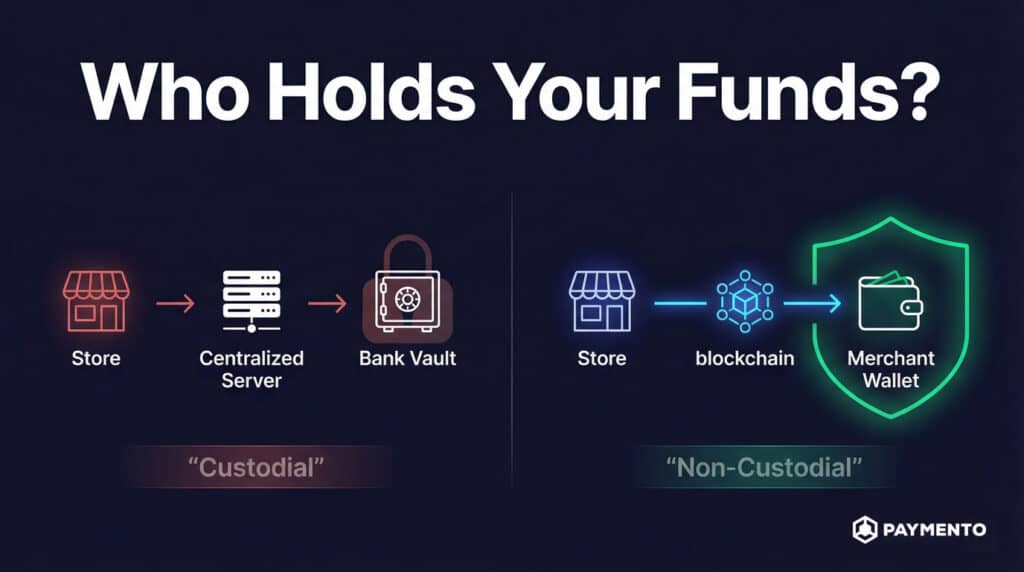
Who holds your money between the moment a customer pays and the moment it reaches to you? For most crypto payment gateways, the honest answer is: they do. And that’s a problem worth understanding before you commit.
What Is a Crypto Payment Gateway, Exactly?
A crypto payment gateway is software that handles the technical process of accepting cryptocurrency from a customer and confirming that payment was received. It generates payment addresses, monitors the blockchain for incoming transactions, confirms them, and notifies your store or system once the payment is complete.
That’s the core function. What varies dramatically between providers is what happens to the funds after confirmation and that’s where custodial and non-custodial models split apart.
A custodial gateway receives the payment on your behalf, holds it in the provider’s wallet, and periodically transfers it to you (usually via bank withdrawal, conversion to fiat, or a separate crypto transfer). You never directly receive the crypto.
A non-custodial gateway generates payment addresses that are mathematically derived from your own wallet. When a customer pays, the funds land directly in your wallet. The gateway never touches them.
Same checkout experience for your customer. Very different architecture for you.
The Custodial Model: How Most Gateways Work (And Why It’s a Problem)
Custodial payment processors have been around since the early days of Bitcoin commerce, and their appeal is understandable. They handle complexity. They convert crypto to fiat automatically. They absorb volatility risk. For a merchant who doesn’t want to think about wallets or blockchains, they seem like the easy path.
But the tradeoffs are significant, and they tend to surface at the worst possible time.
Your funds aren’t yours until they release them. With a custodial provider, you’re an unsecured creditor until the withdrawal clears. This is the same risk structure that burned millions of people during exchange collapses and while a payment processor isn’t an exchange, the legal position is similar if something goes wrong.
Withdrawal delays are built into the model. Most custodial gateways have settlement windows of 24 to 72 hours, sometimes longer. For merchants who need liquidity or want to hold crypto assets directly, this friction is a real operational cost.
Your customers may face unexpected KYC demands. Several custodial processors require payers to verify their identity before completing a transaction not just merchants. This creates friction at checkout that directly kills conversion, especially for international buyers or privacy-conscious customers.
Account freezes happen. Custodial providers can freeze merchant accounts for policy reasons, compliance flags, or internal review. When that happens, your funds are inaccessible, sometimes for weeks. This is not a hypothetical risk.
Platform dependency is total. If the provider has downtime, changes pricing, gets acquired, or shuts down, you’re dependent on their timeline for accessing your own revenue.
None of this means custodial gateways are bad actors. Most are legitimate businesses. But the model itself concentrates risk in a single point of failure that you have no control over.
The Non-Custodial Model: Payments Straight to Your Wallet
A non-custodial gateway removes the intermediary from the money flow entirely. The funds go from your customer’s wallet to yours the gateway just coordinates the process.
Here’s how it works technically, without getting into the weeds: non-custodial gateways use a technology called XPUB (Extended Public Key). Your crypto wallet generates an XPUB, a master public key that can produce an unlimited number of unique receiving addresses, all mathematically linked to your wallet, without ever exposing your private key.
The gateway uses your XPUB to generate a fresh payment address for each transaction. When the customer pays, the funds land at that address, which is already inside your wallet. The gateway monitors the blockchain for confirmation, fires your webhook, and updates your order status. At no point does the gateway have access to move or hold those funds.
The payment flow looks like this:
- Customer initiates checkout
- Gateway generates a unique address derived from your XPUB
- Customer sends payment to that address
- Blockchain confirms the transaction
- Gateway notifies your system via webhook
- Funds are already in your wallet — no transfer needed
No holding period. No settlement window. No counterparty risk.
Custodial vs. Non-Custodial: A Side-by-Side Breakdown
| Custodial | Non-Custodial | |
| Who holds funds after payment | The gateway | Your wallet, directly |
| Settlement time | 24–72 hours (or longer) | Instant, funds arrive on-chain |
| Counterparty risk | High, you’re trusting the provider | None |
| Account freeze risk | Yes | No |
| KYC on your customers | Often required | Optional or not required |
| Private key exposure | N/A (they hold keys) | Zero (XPUB never exposes keys) |
| Provider downtime impact | Can block access to funds | Funds are safe regardless |
| Setup complexity | Low | Low (with the right provider) |
The last row matters. Non-custodial used to mean “hard to set up.” That’s no longer true. With a provider like Paymento, you connect your wallet, generate your XPUB, and you’re live in under ten minutes with the same plugin ecosystem and API access you’d expect from any modern payment gateway.
Who Should Use a Non-Custodial Gateway?
Non-custodial gateways work well across a wide range of business types, but they’re particularly valuable in a few specific situations.
Digital product sellers and SaaS businesses benefit most from instant settlement. If you’re selling software licenses, templates, courses, or subscriptions, the moment a payment confirms on-chain, your product should be delivered. No waiting on a settlement window. Non-custodial gateways make this possible natively.
International merchants often run into painful friction with custodial processors — currency conversion fees, cross-border withdrawal delays, identification requirements that don’t translate across jurisdictions. Non-custodial gateways sidestep most of this because the funds settle in crypto, directly to your wallet, regardless of where you or your customer are located.
Privacy-focused businesses, VPN providers, privacy tools, content platforms, and anyone serving customers who legitimately prefer not to hand over their email or identity benefit from a model where the gateway doesn’t need to collect or store customer data to process a payment. Paymento recently made customer email collection optional entirely, which means payers can complete a transaction without submitting any personal information.
Merchants who hold crypto as a treasury asset have obvious reasons to prefer direct settlement. If your goal is to accumulate USDT, ETH, or BTC rather than convert to fiat, a custodial gateway adds an unnecessary intermediary step and often charges for conversion.
High-volume businesses with tight cash flow requirements can’t afford the unpredictability of custodial settlement timelines. When funds confirm on-chain with a non-custodial gateway, they’re available immediately, with no dependency on the provider’s internal transfer schedule.
Multi-Chain Support: Why It Matters More Than Coin Count
When merchants evaluate crypto gateways, the instinct is to look at coin count. “Does it support 100 coins or 200?” But in practice, the number that matters far more is how many chains are supported and specifically, which chains you can accept USDT on.
Here’s why: USDT is a single stablecoin, but it exists on multiple blockchains. The same dollar-pegged token has very different fee structures, confirmation times, and user bases depending on which chain it travels on.
| Chain | Transaction fee | Confirmation time | Best for |
| Tron (TRC-20) | ~$1 | ~3 minutes | Most merchants — highest adoption, especially Asia |
| Ethereum (ERC-20) | $5–50+ (gas-dependent) | 10–20 minutes | Large transactions where gas cost is a small percentage |
| BNB Chain (BEP-20) | ~$0.20 | ~5 minutes | Mid-range transactions, broad user base |
| Solana (SPL) | <$0.01 | <1 minute | Microtransactions, growing adoption |
If your gateway only accepts USDT on Ethereum, you’re forcing customers who want to pay via Tron to convert chains before they can buy from you. That’s unnecessary friction and you’re charging them $10–50 in gas for the privilege.
A proper multi-chain gateway lets the customer choose which chain they’re sending from. Your wallet receives the funds. You don’t have to manage chain selection on your end at all. Paymento handles this automatically the checkout displays all supported chains, the customer picks the one that works for them, and you get paid.
How to Switch from a Custodial to a Non-Custodial Gateway
If you’re currently using a custodial gateway and want to switch, the process is simpler than most merchants expect.
What you need: A non-custodial crypto wallet that supports XPUB export. Hardware wallets (Ledger, Trezor) and most modern software wallets support this. You’ll generate one XPUB per chain one for USDT on Tron, one for Ethereum, and so on.
What carries over: Your existing payment links, plugin configuration, and customer-facing checkout experience stay largely the same. Paymento’s WooCommerce and WHMCS plugins work with non-custodial architecture by default, there’s no separate “non-custodial mode” to switch on.
Setup time: Under 10 minutes for a basic integration. The Paymento dashboard walks you through entering your public keys per chain, and from that point forward every incoming payment generates a fresh wallet address tied to your wallet.
What you lose: The automatic fiat conversion that custodial gateways often provide. If you need fiat, you’ll convert separately via an exchange. For many merchants, this is a worthwhile tradeoff for the settlement speed and custody benefits. For others who genuinely want automatic fiat conversion, a hybrid approach is possible, settle in crypto, convert on your own schedule via a CEX with better rates than the gateway would give you anyway.
Common Questions About Going Non-Custodial
Is it legal? Yes. Accepting crypto payments directly to your wallet is legal in virtually all jurisdictions. The legal requirements around KYC and AML apply to custodians and financial intermediaries, when you receive payment directly without a custodian in the flow, the regulatory picture is simpler. That said, consult with a legal or compliance advisor for your specific jurisdiction and business type.
What happens if a transaction fails or a customer underpays? The gateway detects underpayments and overpayments automatically and can handle them based on your configured rules. accept, reject, or flag for manual review. Refunds work like any crypto transaction: you send from your wallet back to the customer’s address.
Can I still convert to fiat? Absolutely. Receiving crypto directly to your wallet doesn’t lock you into holding crypto. You can move funds to a centralized exchange and convert whenever you choose on your schedule, not the gateway’s.
Do my customers need a crypto wallet? Yes, any customer paying with crypto needs a wallet to send from. This isn’t a gateway requirement, it’s how blockchain transactions work. The gateway makes the checkout experience as smooth as possible, but customers need to be crypto users to pay with crypto.
Does non-custodial mean no support if something goes wrong? No. Paymento provides support for technical issues, integration problems, and payment disputes regardless of the custody model. The difference is in where the funds live not in whether you have a support team behind the product.
The Bigger Picture
The shift toward non-custodial merchant infrastructure reflects something broader happening in crypto: the realization that the whole point of blockchain payments is direct, permissionless value transfer and that inserting a custodian in the middle defeats that purpose.
Custodial gateways made sense as a transitional solution when the tooling wasn’t good enough to make non-custodial simple. That’s no longer the case. The tools exist. The wallets are accessible. The integrations are just as easy.
With 59% of crypto users now preferring non-custodial wallets, merchants who accept payment directly into their own wallet are aligned with how their customers already think about crypto. That alignment matters for trust.
Non-custodial isn’t a niche technical preference. It’s the direction the whole industry is moving. The merchants who build on non-custodial infrastructure today won’t need to migrate later.
Start Accepting Crypto Directly to Your Wallet
Paymento is a non-custodial crypto payment gateway built for merchants who want direct settlement, multi-chain support, and full control over their funds without sacrificing the plugin ecosystem, API access, or checkout experience they’d expect from any modern payment processor.
Setup takes under 10 minutes. No custody. No withdrawal delays. No surprises.
Have questions about switching from a custodial gateway or setting up XPUB-based payments? Contact our team or explore the developer documentation.