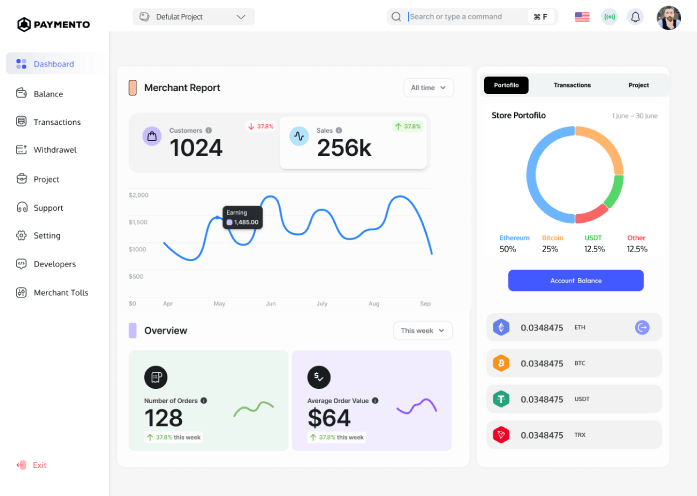
Best Crypto Payment Gateways in 2026 (Ranked for Merchants)
Last updated: June 14, 2026
Best crypto payment gateway comparison guides rank by coin count or brand recognition. Neither tells you what actually matters when you’re running a business.
Coin count is mostly noise, the vast majority of merchant crypto revenue comes from five assets at most: USDT, USDC, Bitcoin, Ethereum, and BNB. A gateway that supports 160 coins but holds your funds, adds hidden withdrawal fees, or forces your customers through identity verification isn’t serving you well regardless of how many assets are on the list.
This guide ranks gateways on five criteria that have direct operational impact: custody model, chain and stablecoin support, fee structure, integration ecosystem, and merchant control. We also flag one important issue that most comparison guides miss entirely, the difference between gateways that claim to be non-custodial and those that actually are.
How We Ranked These Gateways: The 5 Criteria That Actually Matter
1. Custody model: Does the gateway hold your funds between payment and settlement, or do they go directly to your wallet? This single factor affects settlement speed, counterparty risk, withdrawal fees, and your exposure to platform-level problems.
2. Chain and stablecoin support: Can your customers actually pay you? USDT on TRC-20 is the most-used stablecoin network globally. A gateway that doesn’t support it is invisible to the majority of the world’s active stablecoin users.
3. Fee transparency: What you really pay, including network fees, withdrawal fees, and conversion costs. Some gateways advertise low percentage fees while building significant costs into their settlement architecture.
4. Integration ecosystem: Does it work with your platform? WooCommerce, WHMCS, Shopify, payment links, API – the right gateway should fit your existing setup without requiring a rebuild.
5. Merchant control: Can you configure what data you collect from payers? Are your customers forced through KYC? Can you customize the payment experience for your business type?
Here’s how each gateway scores across these five dimensions:
| Gateway | Custody | Chain support | Fee transparency | Integrations | Merchant control | Overall |
| Paymento | ✅ Non-custodial | ✅ Multi-chain USDT | ✅ No hidden fees | ✅ WooCommerce, WHMCS, API, links | ✅ Optional email, no payer KYC | ⭐⭐⭐⭐⭐ |
| NOWPayments | ⚠️ Pseudo-custodial | ✅ 160+ assets | ⚠️ Hidden transfer fee | ✅ API, plugins | ⚠️ Limited control | ⭐⭐⭐⭐ |
| Coinbase Commerce | ❌ Custodial | ⚠️ Base/USDC focus | ⚠️ Withdrawal fees | ✅ Shopify native | ❌ Email required | ⭐⭐⭐⭐ |
| BitPay | ❌ Custodial | ✅ 100+ coins | ❌ Complex, opaque | ⚠️ Enterprise-first | ❌ Heavy payer KYC | ⭐⭐⭐ |
| Cryptomus | ⚠️ Unclear | ✅ 100+ coins | ⚠️ Unclear | ✅ API access | ⚠️ Limited | ⭐⭐⭐ |
| MoonPay | ❌ Custodial | ⚠️ Consumer-focused | ❌ On-ramp fees | ❌ Not merchant-facing | ❌ Heavy KYC | ⭐⭐ |
The 6 Best Crypto Payment Gateways in 2026
#1 Paymento: Best for Non-Custodial Direct Settlement
What it is: A non-custodial crypto payment gateway built specifically for merchants. Funds settle directly to your wallet on every transaction. Paymento never takes possession of your funds at any point.
How it works: Paymento uses XPUB-based address generation. Your wallet produces an extended public key, from which Paymento derives a unique receiving address for each transaction. When a customer pays, the funds land directly at that address — which is already inside your wallet. The gateway monitors the blockchain, confirms receipt, and triggers your webhook. No transfer from Paymento to you happens because the money was never Paymento’s to transfer.
Strengths:
- Genuinely non-custodial — funds go directly to merchant wallet, no intermediary holding period
- Multi-chain USDT support: TRC-20, ERC-20, and Solana SPL from a single integration
- No withdrawal fees — direct settlement means no second network transaction
- Optional payer email — customers can pay without submitting any personal data
- WooCommerce plugin, WHMCS plugin, payment links, full API
- Telegram community automation — automatic member access on payment confirmation
- No mandatory payer KYC
Weaknesses:
- No native Shopify integration (API-based integration is possible but requires setup)
- No automatic fiat conversion — merchants who want USD in their bank account need to convert via exchange separately
- No built-in refund mechanism — crypto transactions are irreversible; merchants handle refunds manually outside the platform
- Shorter operational track record than BitPay or Coinbase Commerce
Best for: WooCommerce store owners, WHMCS hosting providers, international merchants, privacy-focused businesses, Telegram community monetization, any merchant who wants funds in their wallet without a settlement window.
Pricing: Percentage per transaction. No withdrawal fees. No monthly fees for standard plans.
#2 NOWPayments: Best for Coin Variety, But Read the Fine Print
What it is: A crypto payment processor that supports over 160 cryptocurrencies and markets itself as non-custodial. The coin variety is genuine. The non-custodial claim requires closer examination.
The custody reality and why it matters:
NOWPayments describes itself as non-custodial, but the technical architecture tells a different story. When a customer initiates a payment, NOWPayments generates a temporary deposit address but that address belongs to NOWPayments, not to the merchant. The customer’s funds land in NOWPayments’ wallet first. NOWPayments then initiates a second transfer to send the funds to the merchant’s wallet.
This is functionally custodial. The distinction matters for three reasons:
First, the merchant pays a hidden network fee. The second transfer from NOWPayments’ wallet to the merchant’s wallet is a separate on-chain transaction that costs a network fee. That fee is deducted from the merchant’s settlement amount. A merchant expecting to receive $100 USDT receives $99 or less, depending on the chain and current network conditions. On Ethereum, this deduction can be significant.
Second, the funds are legally in NOWPayments’ possession. During the window between the customer’s payment arriving at NOWPayments’ address and the forwarding transfer completing, those funds are technically NOWPayments’ liability. If NOWPayments experiences technical issues, regulatory action, or insolvency during that window, the merchant’s recourse is as an unsecured creditor, the same legal position as any custodial arrangement.
Third, the non-custodial claim creates a false sense of security. Merchants who choose NOWPayments specifically because they want non-custodial settlement may not realize they’re actually using a custodial intermediary with an extra step. The marketing language is misleading in a way that affects a merchant’s risk assessment.
A genuinely non-custodial gateway like Paymento never generates a temporary address in its own wallet. The receiving address is derived from the merchant’s own XPUB and exists inside the merchant’s wallet from the moment it’s generated. No transfer from the gateway to the merchant ever occurs because the funds were never the gateway’s to transfer.
Legitimate strengths:
- 160+ cryptocurrencies — the widest asset support of any gateway in this list
- API-first architecture works well for developers
- Reasonable documentation and integration support
- Good option for merchants who genuinely need obscure altcoin support
Weaknesses:
- Pseudo-custodial architecture despite non-custodial marketing claims
- Hidden network fee on settlement transfer reduces merchant’s received amount
- Weaker brand and support infrastructure compared to larger competitors
- Less polished merchant dashboard and onboarding experience
Best for: Merchants who specifically need support for less common cryptocurrencies and are comfortable with the custody tradeoffs.
#3 Coinbase Commerce: Best for Shopify Merchants
What it is: Coinbase’s merchant payment product, custodial by design, with strong Shopify integration and a clear strategic direction toward USDC on Base — Coinbase’s own Layer 2 blockchain.
In early 2026, Coinbase launched “Coinbase Payments” as a broader commerce infrastructure play, and the x402 Foundation targeting AI-agent payments. Both moves deepen Coinbase’s ecosystem lock-in around Base and USDC which is good for merchants building within that ecosystem and a gap for everyone else.
Strengths:
- Native Shopify integration is genuinely strong
- Brand recognition provides customer trust at checkout for some audiences
- USDC support is solid — good for US-centric merchants
- Managed fiat conversion available for merchants who want automatic USD settlement
- High uptime and enterprise-grade reliability
Weaknesses:
- Custodial, your funds are in Coinbase’s wallet until withdrawal
- Settlement delays and withdrawal fees built into the model
- Strongly Base/USDC-focused limited TRC-20 USDT support, which is the most-used stablecoin network globally
- Requires payer email, no anonymous payment option
- Payer KYC sometimes required depending on transaction parameters
- Platform dependency: account freezes or compliance reviews affect fund access
Best for: Shopify merchants primarily serving US customers, merchants who want managed fiat conversion, businesses already embedded in the Coinbase/Base ecosystem.
#4 BitPay: Best for Enterprise and Established Brand Trust
What it is: One of the oldest crypto payment processors, founded in 2011. BitPay has the longest track record in the industry and strong relationships with enterprise clients. Their product has evolved from a Bitcoin-focused processor to a multi-coin custodial gateway with 100+ supported assets.
Strengths:
- Longest operational track record in crypto payment processing
- 100+ supported cryptocurrencies
- Strong enterprise relationships and compliance infrastructure
- Recognized brand in crypto payments, particularly among older merchant demographics
Weaknesses:
- Custodial, full custody model with settlement delays and withdrawal fees
- Heavy KYC requirements on payers, customers frequently required to verify identity before completing a payment, which creates significant checkout friction
- Complex and opaque fee structure, multiple fee layers including conversion fees, network fees, and settlement fees
- Enterprise-first product design, small and mid-size merchants often find the onboarding and configuration heavyweight for their needs
- Limited focus on merchant UX improvements in recent years
Best for: Large enterprises, businesses with compliance-heavy requirements, merchants where the BitPay brand name carries specific value with their customer base.
#5 Cryptomus: Best for High Volume on a Budget
What it is: A crypto payment processor supporting 100+ cryptocurrencies with competitive percentage fees. Cryptomus has been building publishing frequency and brand presence, though primarily through trading-focused educational content rather than merchant infrastructure thought leadership.
Strengths:
- Competitive fee structure, particularly for higher transaction volumes
- 100+ cryptocurrency support
- API access for custom integrations
- Active in content marketing — reasonably well documented
Weaknesses:
- Custody model is not clearly disclosed — merchants should verify directly whether funds are held before committing
- Weaker brand credibility than established players — less track record to evaluate reliability
- Support infrastructure less proven than larger competitors
- Content strategy is primarily trading/speculation-focused, suggesting the merchant payment product may not be their core priority
- Limited integration ecosystem compared to Paymento or Coinbase Commerce
Best for: High-volume merchants comfortable with a less-established provider who have done their own due diligence on the custody model and reliability.
#6 BTCPay Server: Best for Self-Hosted, Zero-Fee Control
What it is: BTCPay Server is a free, open-source, self-hosted crypto payment processor. Unlike every other gateway on this list, there is no company behind it — it is software you run on your own server. No percentage fee, no intermediary, no account that can be suspended.
Strengths:
- Genuinely free — zero transaction fees beyond blockchain network costs
- Fully non-custodial — funds go directly to your wallet, no intermediary at any point
- No account suspension risk — no company can freeze your gateway
- Strong Bitcoin and Lightning Network support
- WooCommerce and Shopify integrations available
- Active open-source community with a long track record
Weaknesses:
- Requires technical setup — server deployment, maintenance, and updates are the merchant’s responsibility
- Primarily Bitcoin-focused — altcoin and stablecoin (USDT, USDC) support requires additional configuration
- No managed support team — you are your own support
- Monthly server hosting cost ($5–20/month VPS) replaces the percentage fee
Best for: Technically capable merchants who want zero percentage fees and complete payment sovereignty — particularly Bitcoin-focused businesses and merchants who have been burned by custodial account freezes.
Pricing: Free software. You pay server hosting and blockchain network fees only. No percentage fee to any third party.
#7 CoinGate: Best for European Merchants Wanting Fiat Settlement
What it is: CoinGate is a Lithuania-based licensed payment processor, regulated under EU financial law. It supports 70+ cryptocurrencies and offers automatic EUR/USD settlement via bank transfer — one of the few gateways that bridges crypto payments directly to a fiat bank account within a regulated European framework.
Strengths:
- EU-regulated — licensed payment institution for merchants who need a formal regulated provider relationship
- Automatic fiat settlement — crypto received, EUR or USD deposited to your bank account
- 70+ cryptocurrencies including Bitcoin, USDT TRC-20, Ethereum, and Solana
- WooCommerce, PrestaShop, Magento, and OpenCart plugins
- Payment links and point-of-sale support
Weaknesses:
- Custodial — funds are held by CoinGate during the settlement process
- Fiat settlement adds a conversion fee and FX risk
- KYC required for merchants and sometimes payers
- Higher total cost than non-custodial alternatives when conversion fees are included
Best for: European merchants who need a regulated payment provider, want crypto accepted but EUR settled to a bank account, or operate in sectors where a licensed institution relationship provides compliance comfort.
Pricing: 1% transaction fee plus conversion spread on fiat settlement.
#8 MoonPay: Best for Consumer On-Ramping (Not Merchant Payments)
What it is: MoonPay is primarily a consumer crypto on-ramp and wallet product, not a merchant payment gateway. It allows consumers to buy crypto with fiat, and has recently launched wallet-to-wallet transfer features (MoonPay Deposits). With 30M+ users and partnerships including a Deel integration for stablecoin payroll, MoonPay is a significant platform, just not the right one for merchants accepting crypto payments.
Including MoonPay in this list because it frequently appears in crypto payment gateway searches, and merchants deserve a clear explanation of why it’s a different product category.
Why it’s not a merchant payment gateway:
- Designed for consumers buying crypto with cards, not businesses receiving crypto from customers
- No merchant checkout integration — no WooCommerce, WHMCS, or store plugins
- No payment links for merchant invoicing
- Heavy KYC focus across all transactions (compliance is a core product feature, not an option)
- Fee structure built around on-ramp margins, not merchant processing
What it’s actually good for: Platforms that want to let their users purchase crypto within their app, payroll providers distributing stablecoin salary, consumer wallet features.
Best for: Platforms and apps wanting consumer crypto on-ramp integration — not merchants accepting payments.
Full Side-by-Side Comparison Table
| Feature | Paymento | NOWPayments | Coinbase Commerce | BitPay | Cryptomus | MoonPay |
| Custody model | Non-custodial ✅ | Pseudo-custodial ⚠️ | Custodial ❌ | Custodial ❌ | Unclear ⚠️ | Custodial ❌ |
| Direct wallet settlement | ✅ | ❌ | ❌ | ❌ | ⚠️ | ❌ |
| USDT TRC-20 | ✅ | ✅ | ❌ | ✅ | ✅ | ❌ |
| USDT multi-chain | ✅ | ✅ | ❌ | ⚠️ Limited | ✅ | ❌ |
| Solana support | ✅ | ✅ | ⚠️ | ⚠️ | ⚠️ | ❌ |
| WooCommerce plugin | ✅ | ✅ | ✅ | ✅ | ✅ | ❌ |
| WHMCS plugin | ✅ | ✅ | ❌ | ❌ | ⚠️ | ❌ |
| Shopify native | ⚠️ API only | ⚠️ API only | ✅ | ⚠️ | ⚠️ | ❌ |
| Payment links | ✅ | ✅ | ✅ | ✅ | ✅ | ❌ |
| Telegram automation | ✅ | ❌ | ❌ | ❌ | ❌ | ❌ |
| Payer email required | ❌ Optional | ✅ | ✅ | ✅ | ✅ | ✅ |
| Payer KYC required | ❌ | ⚠️ | ⚠️ Sometimes | ✅ Heavy | ⚠️ | ✅ Heavy |
| Withdrawal fees | ❌ None | ✅ Hidden transfer fee | ✅ Yes | ✅ Yes | ⚠️ Unclear | N/A |
| Merchant-facing product | ✅ | ✅ | ✅ | ✅ | ✅ | ❌ |
Which Crypto Payment Gateway Should You Choose?
Rather than a generic recommendation, here’s a decision guide based on your actual situation:
You use WooCommerce → Paymento. Strong native plugin, non-custodial, multi-chain USDT from day one.
You use WHMCS → Paymento. It’s one of the only gateways with a proper WHMCS integration. Coinbase Commerce and BitPay don’t support it.
You use Shopify and serve primarily US customers → Coinbase Commerce is the most frictionless fit. If your customers are international and use USDT on Tron, reconsider.
You serve customers in Asia, Middle East, Eastern Europe, or Latin America → Paymento. These markets run primarily on USDT TRC-20. A gateway without strong TRC-20 support leaves a significant portion of your potential customers unable to pay easily.
You need 150+ altcoins including obscure assets → NOWPayments. Just go in with clear eyes about the custody reality — you will receive slightly less than the invoiced amount due to the forwarding transfer fee, and funds do pass through their wallet.
You’re an enterprise with compliance requirements → BitPay or Paymento. BitPay has the longer enterprise track record; Paymento has the better non-custodial architecture and is growing fast.
You serve privacy-conscious customers (VPN, security tools, digital content) → Paymento. The only gateway on this list where payer email is optional and customers can complete a transaction without submitting personal data.
You run a Telegram community or subscription group → Paymento, exclusively. No other gateway on this list has native Telegram automation.
You want to build a consumer crypto on-ramp into your app → MoonPay. It’s a different product category entirely, but it’s the right one for that use case.
What to Watch Out for in Any Crypto Gateway
Before committing to any gateway, these are the questions worth asking directly:
“Is your gateway truly non-custodial, or do funds pass through your wallet first?” This question will separate genuinely non-custodial architecture from pseudo-custodial systems that use non-custodial marketing language. Ask for a technical explanation of how receiving addresses are generated and whether the gateway wallet is ever in the payment flow.
“What is the total fee on a $100 USDT TRC-20 payment, including all network and transfer fees?” Gateway percentage fees are easy to find. Withdrawal fees, forwarding fees, and conversion costs are often not. Get the complete number.
“Do you require payers to submit personal information or complete KYC?” Some gateways require customer identity verification at checkout without making this clear during merchant onboarding. This is checkout friction you inherit and your customers experience.
“What happens to my funds if your platform has downtime or my account is flagged?” Custodial gateways hold your money. The answer to this question tells you your actual risk exposure.
“What chains do you support for USDT?” The correct answer for most merchants should include at minimum TRC-20 and ERC-20. If the answer is primarily Base or a single chain, understand what portion of global USDT users that excludes.
Frequently Asked Questions
What is the cheapest crypto payment gateway? “Cheapest” depends on what you count. On percentage fees alone, most gateways are within a similar range. The real cost difference is in withdrawal and transfer fees. Non-custodial gateways like Paymento have no withdrawal fee because funds go directly to your wallet, no second transfer needed. Pseudo-custodial gateways like NOWPayments deduct a network fee from every settlement transfer. Over volume, this difference is significant.
Is there a truly non-custodial crypto payment gateway? Yes, Paymento uses XPUB-based address generation, meaning receiving addresses are derived from the merchant’s own wallet. Funds never enter a Paymento-controlled wallet at any point. NOWPayments claims non-custodial status but uses a temporary intermediate wallet before forwarding to merchants — which is technically custodial and results in a deducted network fee on settlement.
What’s the best crypto gateway for WooCommerce? Paymento has the most complete WooCommerce integration among non-custodial gateways. Coinbase Commerce and BitPay also have WooCommerce plugins but with custodial architecture.
Can I accept USDT on TRC-20 with these gateways? Paymento, NOWPayments, and BitPay support TRC-20 USDT. Coinbase Commerce is primarily Base/USDC focused and has limited or no TRC-20 support. For merchants with global customer bases — particularly in Asia and emerging markets — TRC-20 support is essential.
Which gateway is best for international merchants? Paymento. Multi-chain USDT support covers the networks that international customers actually use, non-custodial architecture avoids currency conversion friction, and optional payer email removes the data collection barrier that international buyers sometimes encounter with US-centric payment infrastructure.
Why does it matter if a gateway is “pseudo-custodial” vs truly non-custodial? Three reasons: fees, risk, and legal exposure. Pseudo-custodial gateways deduct a network fee from every settlement because they run a second transfer transaction. They hold your funds in their wallet during that window, creating counterparty risk. And legally, during the period funds sit in their wallet, they are the custodian — with all the regulatory obligations and risk that entails. A truly non-custodial gateway avoids all three of these issues.
The Bottom Line
The best crypto payment gateway for most merchants in 2026 is one that puts funds directly in your wallet, supports USDT across the chains your customers actually use, doesn’t require personal data from payers, and integrates with your existing platform.
Paymento is the only gateway on this list that satisfies all four criteria simultaneously. NOWPayments comes closest on asset variety but falls short on genuine non-custodial architecture. Coinbase Commerce is the right choice specifically for Shopify merchants in US markets. BitPay serves enterprise needs with the longest track record. Cryptomus is worth evaluating for high-volume merchants who’ve done their homework on the custody question.
The question that cuts through all of it: when your customer pays, where does the money go first? If the answer is anything other than “directly into your wallet,” you’re using a custodial product — regardless of what the marketing says.
Get started with Paymento – genuinely non-custodial, multi-chain, direct to your wallet →