How Hosting Providers Can Eliminate Chargebacks with Crypto Payments (WHMCS Setup)
If you run a web hosting business, you already know the math. Card chargebacks cost the hosting industry somewhere between 2% and 5% of gross revenue. Not declined transactions. Chargebacks. Disputes where a customer used a service, then asked their bank to claw the money back.
Stripe and PayPal aren’t the solution. They’re often part of the problem. Hosting is categorized as high-risk by most payment processors, which means higher fees, reserves, and account closures with no warning.
Crypto payments don’t solve every merchant problem. But for chargebacks specifically, they solve it structurally. Not through a dispute policy, but through how blockchain transactions work.
Why Hosting Businesses Have a Chargeback Problem
A chargeback happens when a cardholder disputes a transaction with their bank. The bank reverses the payment. The merchant loses the funds and pays a chargeback fee, typically $15-$25 per dispute.
Hosting businesses are particularly exposed for three reasons.
Service is intangible. There’s no physical delivery to prove. A customer can claim they never received the service, and banks often side with the cardholder.
International customer base. Cross-border transactions have higher fraud rates and dispute rates. Processors apply higher fees or decline to serve these merchants at all.
High-risk category. Payment processors flag web hosting as high-risk due to the industry’s elevated chargeback history. That means reserves (processors hold a percentage of your revenue), elevated transaction fees, and arbitrary account closures.
The result: hosting operators spend real time managing disputes, funding reserves, and navigating processor restrictions that were never designed for their business model.
How Crypto Eliminates Chargebacks
This is not a policy change. It’s how blockchains work.
A crypto transaction is signed by the sender’s private key and broadcast to the network. Once confirmed, it is permanently recorded on the blockchain. There is no bank, no card network, and no dispute process that can reverse it.
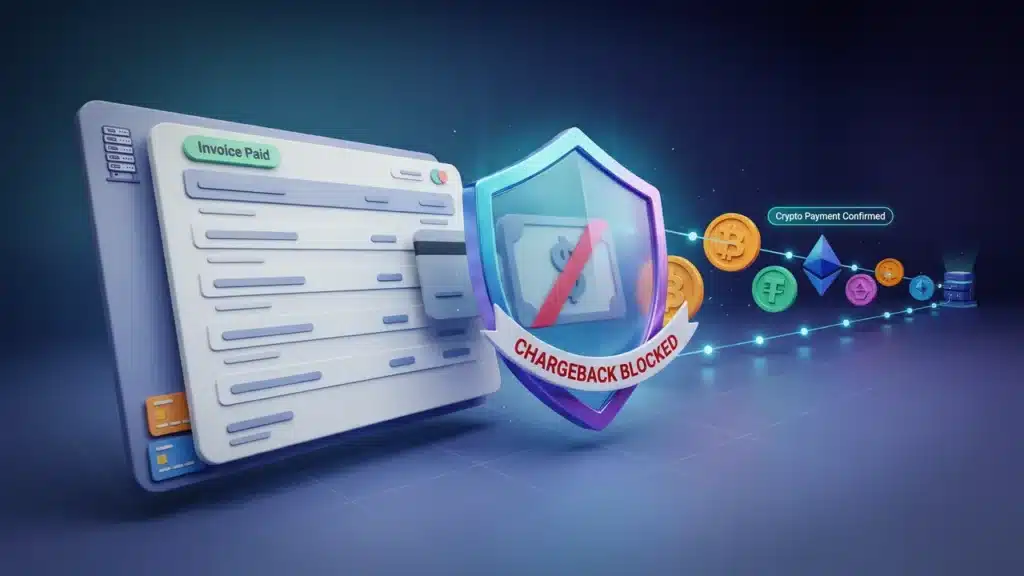
When a customer pays for hosting with USDT or Bitcoin, the transaction is final at confirmation. There is no mechanism for reversal. Chargeback risk is zero. Not low. Zero.
This is not a payment processor policy that can change next quarter. It is a property of cryptographic transaction finality.
Non-Custodial vs Custodial: The Distinction That Matters
Before choosing a crypto payment gateway, hosting operators should understand one critical architectural difference.
Custodial gateways hold your funds. Payments from customers go into the gateway’s wallet. You then request a withdrawal to your own wallet. This creates counterparty risk: if the gateway freezes accounts, pauses withdrawals, or goes out of business, your revenue is locked. This is the model used by several well-known crypto payment services.
Non-custodial gateways like Paymento route payments directly to your wallet. Your wallet address is the destination from the moment the invoice is created. The gateway monitors the blockchain but never holds your funds. There is no withdrawal step. Funds arrive in your wallet at confirmation.
Paymento is non-custodial. Every payment goes directly into your own wallet. Paymento has no access to those funds at any point.
For a hosting operator who has already experienced processor account freezes, this distinction is the entire value proposition.
WHMCS Integration: How It Works
WHMCS is the billing system most hosting businesses run. Paymento has a native WHMCS module that integrates directly with your billing workflow.
What the integration does
- Generates a crypto invoice automatically when a client places an order or renews a service
- Monitors the blockchain for payment confirmation
- Updates the WHMCS invoice status from Pending to Paid without manual intervention
- Fires webhook callbacks on every payment state change
- Supports Bitcoin, Litecoin, Ethereum, Tron, Solana, and major tokens including USDT (TRC-20, ERC-20, Solana SPL) and USDC
Installation steps
1. Download the module
Available from the Paymento WHMCS plugin or your Paymento dashboard.
2. Upload module files
Copy the files to your WHMCS installation under /modules/gateways/.
3. Configure in WHMCS admin
Navigate to Setup > Payment Gateways > Paymento. Enter your Paymento API key and your wallet addresses for each chain you want to accept.
4. Select which currencies to accept
Most hosting operators start with USDT on Tron (low network fees, confirmation in 1-2 minutes) and Bitcoin (widest adoption among clients). Add chains based on your customer demand.
5. Go live
Paymento appears as a payment option at checkout. Clients select it, see an invoice with the wallet address and exact amount, and send payment from their own wallet. No client account required. No card information. No chargebacks.
Fee comparison: card processing vs crypto
| Card processing (high-risk) | Paymento | |
|---|---|---|
| Per-transaction fee | 3-5% + $0.30 | 0.5% |
| Chargeback fee | $15-$25 per dispute | None |
| Rolling reserve | 5-10% of monthly volume | None |
| Account freeze risk | Yes | No |
| Setup fee | Often $100-$500 | None |
On $50,000/month in billing, the difference between a 3.5% high-risk card rate and Paymento’s 0.5% is $1,500/month, before counting chargeback losses and reserve lockup.
What to Tell Your Clients
Most hosting clients who pay by card have never thought about crypto payments. The conversation is straightforward.
No account required. Crypto payments work from any wallet. Clients do not need to register with Paymento or your hosting company to pay.
Pay with stablecoins to avoid price swings. USDT and USDC are pegged to USD. Clients pay the same USD-denominated price they would with a card. Paymento handles the conversion at checkout. No currency risk.
Faster than bank transfers. A USDT-Tron payment confirms in 1-2 minutes. No multi-day bank processing delays.
You don’t need your clients to be crypto experts. You need them to have a wallet, which takes five minutes to set up for anyone who doesn’t already have one.
What This Doesn’t Solve
Crypto payments eliminate chargebacks. They don’t eliminate every merchant problem.
Refunds are manual. Crypto transactions are irreversible. If a client cancels service and is owed a partial refund, you initiate it from your own wallet. Build your refund workflow into your support process before going live.
Compliance remains your responsibility. Non-custodial architecture means Paymento does not impose KYC requirements on your clients. Your compliance obligations as a merchant depend on your jurisdiction and business structure. Non-custodial does not mean non-compliant. Consult your legal advisor for your specific situation.
Not every client will use it. Crypto works as an option alongside existing card processing. The goal is shifting a portion of your high-risk or international billing to crypto, reducing chargeback exposure on that segment. You don’t need 100% adoption to eliminate most of your chargeback problem.
Getting Started
Paymento’s WHMCS module installs in under 30 minutes. Your first $3,000 in processed payments is free, with no setup fee and no monthly cost.