How to Accept Crypto Payments in WHMCS: Complete Setup Guide (2026)
WHMCS is the backbone of thousands of web hosting businesses, domain registrars, VPS providers, and infrastructure companies worldwide. Most run on a combination of PayPal, Stripe, and bank transfers for billing. A growing number are adding crypto — and for hosting businesses specifically, the case is stronger than for almost any other industry.
Your customers are disproportionately technical. Many of them already hold crypto. A significant portion are in regions where card-based payments are unreliable, expensive, or simply not available. And the payment problems that hosting businesses deal with — PayPal holds, chargeback disputes on digital goods, international card declines — are exactly the problems that crypto payments eliminate.
This guide covers the complete Paymento WHMCS plugin setup, from downloading the module to your first successfully paid invoice, with everything you need to know about recurring billing and troubleshooting along the way.
Why Hosting Providers and WHMCS Users Are Adding Crypto Payments
Your customers already have crypto. Web hosting, VPS, and domain customers skew heavily technical; developers, system administrators, digital entrepreneurs. This demographic has one of the highest rates of crypto ownership of any industry vertical. You’re not trying to convince your customers to use an unfamiliar payment method. You’re adding support for one they already use.
International customers face real card friction. The global market for web hosting and infrastructure services includes enormous demand from Southeast Asia, Eastern Europe, the Middle East, and Latin America. These are regions with high technical sophistication, strong demand for hosting services, and persistent problems with international card payments, declined transactions, high FX fees, limited card acceptance at Western processors. Customers in these markets holding USDT on TRC-20 can pay a WHMCS invoice instantly, for under $1 in network fees, with no currency conversion and no card decline.
No chargebacks — ever. This is a specific and significant benefit for hosting providers. Digital service chargebacks are notoriously difficult to dispute. A customer uses a month of VPS service, pays with a card, then initiates a chargeback claiming the service was unsatisfactory. The card network typically sides with the cardholder. The hosting provider loses both the revenue and the month of service already delivered. Crypto transactions are irreversible by design. Once confirmed on the blockchain, there is no reversal mechanism. No chargeback. No dispute. No lost revenue.
Direct wallet settlement. With Paymento’s non-custodial architecture, every payment goes directly to your configured wallet the moment it confirms on-chain. No payment processor holding your revenue. No withdrawal request. No 2-day rolling settlement. The money is yours immediately.
Lower fees. Paymento charges 0.5% per transaction — compared to PayPal’s 3.49% or Stripe’s 2.9% + $0.30. On $5,000/month in billing volume, that fee difference is over $1,400/year kept in your business instead of paid to a payment processor. New Paymento accounts also receive $100 in free credit, so your first transactions cost nothing.
No KYC on your customers. Paymento doesn’t require identity verification from payers. Customers select crypto at checkout and pay; no account creation, no ID submission, no friction that might cause them to abandon the invoice.
What You Need Before Installing
Make sure your environment meets these requirements:
| Requirement | Minimum version |
| WHMCS | 7.0 or higher (fully tested on 8.0–8.12) |
| PHP | 7.2 or higher |
| cURL extension | Must be enabled |
You’ll also need:
- A Paymento merchant account — free to create at app.paymento.io
- Your API key and Secret key — generated in the Paymento dashboard
- Your wallet configuration — addresses for account-based chains (Ethereum, Tron, Solana) or XPUB for Bitcoin, set up in your Paymento dashboard
To verify your PHP version and cURL status in WHMCS: go to Utilities → System → PHP Info in your WHMCS admin panel. You’ll see your PHP version and all enabled extensions listed there.
Step 1: Download the Plugin
Go to the Paymento plugin page on the WHMCS Marketplace and click Get It Now. The plugin is free, no purchase or license required.
You’ll download a ZIP file containing the plugin module. Extract it before uploading inside; you’ll find a modules folder which is what you need for the next step.
Step 2: Upload to Your WHMCS Server
This step is where most first-time WHMCS module installations trip up, the key is merging the folders correctly rather than replacing them.
Your WHMCS installation already has a modules folder in its root directory. The plugin’s modules folder needs to be uploaded into the same location so the contents merge. Do not delete or replace your existing modulesfolder that would remove other modules you have installed.
Via FTP or SFTP (recommended):
- Connect to your server using your FTP client (FileZilla, Cyberduck, or similar)
- Navigate to your WHMCS root directory — typically something like /public_html/whmcs/ or /var/www/whmcs/
- Upload the extracted modules folder from the plugin ZIP
- When prompted about merging folders, choose Merge (not Replace)
- The gateway file will be placed at: [whmcs-root]/modules/gateways/paymento.php
Via cPanel File Manager:
- Log into cPanel and open File Manager
- Navigate to your WHMCS root directory
- Click Upload and select the plugin ZIP file
- Once uploaded, right-click the ZIP and select Extract
- Move the extracted modules/gateways/paymento.php file to [whmcs-root]/modules/gateways/
After uploading, verify the file exists at the correct path before moving to the next step. If the file isn’t in the right location, WHMCS won’t find the gateway.
Step 3: Activate the Plugin in WHMCS Admin
With the file uploaded, activate the gateway from your WHMCS admin panel:
- Log into your WHMCS Admin Panel
- Go to Setup → Payment Gateways
- Click the All Payment Gateways tab
- Scroll through the list or search for “Paymento”
- Click Activate
Once activated, Paymento moves to the Manage Existing Gateways tab. You’ll configure it there in the next step.
If Paymento doesn’t appear in the list after uploading the file, double-check the file path. The gateway file must be at [whmcs-root]/modules/gateways/paymento.php — not in a subdirectory within gateways.
Step 4: Configure Your API Keys
Go to Setup → Payment Gateways → Manage Existing Gateways and find Paymento in the list.
You’ll see the following configuration fields:
Display Name — The payment method label shown to customers on your invoice payment page. Something like “Crypto Payment” or “Pay with Bitcoin / USDT” works well. Keep it descriptive so customers understand what they’re selecting.
API Key — Paste your Paymento API key here. This is your merchant identifier for all API communication. Get it from your Paymento dashboard under API Key Generation.
Secret Key — Paste your Paymento secret key here. This is used by the plugin to verify that payment callbacks genuinely came from Paymento (HMAC signature verification). Never share this key or expose it publicly.
Once you enter both keys and click Save Changes, the plugin automatically communicates with the Paymento API to:
- Verify your API key is valid
- Retrieve your merchant account details
- Configure your IPN (Instant Payment Notification) callback URL automatically — you don’t need to set this manually anywhere. The plugin handles it during first-time setup, registering your WHMCS callback endpoint with Paymento so payment status updates flow back to your system correctly.
This automatic IPN configuration is one of the plugin’s most practical features. With some WHMCS payment integrations, configuring the callback URL requires manual steps across both systems. Paymento handles it entirely on first save.
Step 5: Configure Your Wallet in the Paymento Dashboard
The WHMCS plugin handles the billing side — but you also need to tell Paymento where to send your money.
For account-based chains (Ethereum, Tron, BNB Chain, Solana):
- Log into your Paymento dashboard at app.paymento.io
- Go to payment settings
- Enter your wallet address for each chain you want to accept payments on
- Connect your wallet for signing:
- MetaMask — for Ethereum and BNB Chain
- TronLink — for Tron
- WalletConnect — for mobile wallets
- Complete the signing step to link your wallet address to your merchant account
For Bitcoin:
- Export your XPUB from your hardware wallet (Ledger or Trezor)
- Enter the XPUB in your Paymento dashboard under Bitcoin settings
- Paymento will derive unique addresses per transaction, all landing in your wallet
Enable only the chains you’re comfortable supporting. For most hosting businesses, starting with USDT on TRC-20 and Ethereum covers the majority of customer demand. You can add more chains later without reinstalling anything.
Step 6: Test with a Real Invoice
Never skip testing before pointing live customers at a new payment gateway.
Create a test invoice:
- In your WHMCS admin, go to Billing → Create Invoice
- Create a small test invoice (you can use $1 or any small amount)
- Assign it to a test client account
Run through the customer flow:
- Log into the WHMCS client area as your test client
- View the open invoice
- Click Pay Now
- Select Paymento / crypto as the payment method
- Confirm you’re redirected to the Paymento payment gateway
- Verify the gateway shows the correct invoice amount and available chains
Complete a test payment:
Use Paymento’s testing and simulation environment to simulate a completed payment without spending real crypto. After the simulated payment:
- Confirm the invoice status in WHMCS updates to Paid
- Confirm the payment appears in your Paymento dashboard
- Check that WHMCS sent the payment confirmation email to the test client
Verify the IPN is working:
Go to WHMCS Admin → Utilities → Logs → Gateway Log. You should see callback entries from Paymento after your test payment. If the log is empty, the callbacks aren’t reaching WHMCS — check your server firewall and the troubleshooting section below.
What the Customer Experience Looks Like
From your customer’s perspective, paying a WHMCS invoice with crypto works like this:
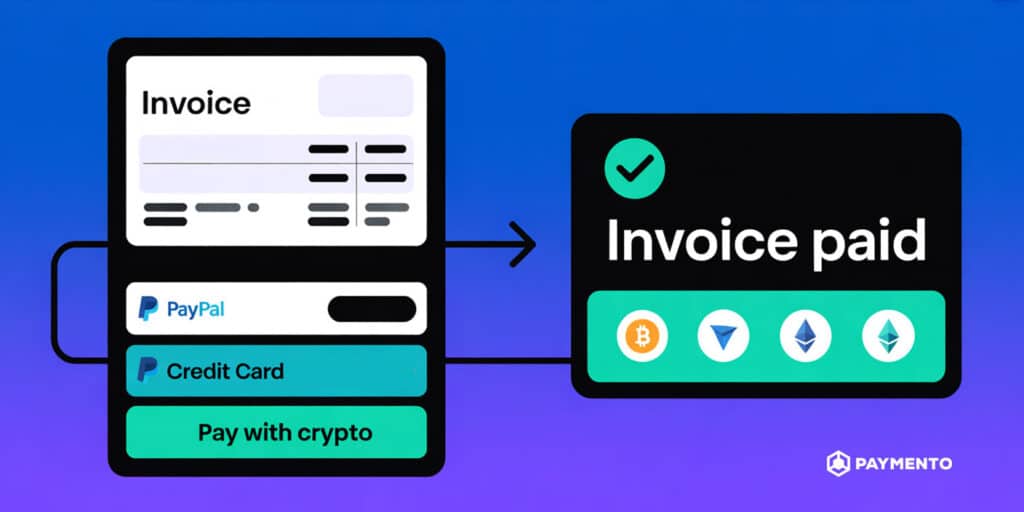
- Customer receives an invoice email from WHMCS with a Pay Now link
- They click through to the WHMCS client area and view the open invoice
- They select Paymento (or your chosen display name) from the payment method options
- They’re redirected to the Paymento hosted payment page
- They select their preferred cryptocurrency and chain (e.g. USDT on TRC-20)
- A payment address and QR code appear with a countdown timer
- They send the payment from their wallet or initiate an exchange withdrawal to the address
- After on-chain confirmation, they’re redirected back to the WHMCS client area
- The invoice is automatically marked as Paid and the relevant WHMCS automation triggers (service activation, renewal, etc.)
The entire crypto complexity is contained within the Paymento payment page. Your WHMCS automation — service provisioning, renewal processing, email notifications — all trigger normally based on the invoice paid status, exactly as they would for PayPal or Stripe.
Crypto Payments and WHMCS Recurring Invoices
This is the most common question hosting providers ask about crypto billing, so it deserves a clear answer.
Crypto does not support automatic card-style charge initiation. You cannot configure Paymento to automatically charge a customer’s wallet when their renewal is due — that’s not how blockchain transactions work. Customers must actively initiate each payment.
This works fine for hosting billing — here’s why:
WHMCS’s invoice-based billing model already maps naturally to how crypto payments work. When a renewal is due, WHMCS generates an invoice and sends the customer an email notification. The customer clicks the payment link, selects crypto, and pays. The invoice is marked paid. The service renews.
This is the same workflow your customers already follow if they pay manually via PayPal or bank transfer. You’re not introducing new behaviour — you’re adding a new payment option within an existing flow.
Best practices for crypto recurring billing in WHMCS:
Set your invoice generation to occur several days before the due date — this gives customers time to make the payment without their service being interrupted. WHMCS’s default is typically 14 days before renewal, which is fine. Make sure your invoice email template clearly mentions that crypto payment is available and includes the direct payment link.
For customers who want to pay in USDT, consider noting in your invoice emails that TRC-20 USDT has a ~$1 network fee and confirms in about 3 minutes — removing this uncertainty upfront reduces support questions.
WHMCS Crypto vs PayPal and Stripe for Hosting Businesses
| Paymento Crypto | PayPal | Stripe | |
| Transaction fee | 0.5% | 3.49% | 2.9% + $0.30 |
| Chargebacks | None — irreversible | Yes | Yes |
| International customers | Excellent | Good | Good |
| Settlement | Instant to your wallet | Holds possible | 2-day rolling |
| Account freeze risk | None | Known issue for hosting | Possible |
| Payer KYC | Not required | Not required | Not required |
| Recurring auto-charge | Not supported | Supported | Supported |
| Setup cost | Free | Free | Free |
The one column where PayPal and Stripe win is automatic recurring charge initiation. If that’s critical to your business model, crypto works best as a complement to your existing payment methods rather than a replacement. Most WHMCS hosting businesses run multiple payment gateways simultaneously, Paymento alongside PayPal and Stripe is a common and sensible setup.
Paymento vs Other WHMCS Crypto Gateways
The WHMCS Marketplace lists several crypto payment options. Here’s how they compare:
CoinGate for WHMCS — Custodial. Payments go to CoinGate’s wallet and are settled to you on their schedule. Supports multiple coins with fiat conversion option. Good choice if you want automatic fiat conversion managed by the provider. Downside: custody, settlement delays, withdrawal fees.
Coinbase Commerce for WHMCS — Custodial. Primarily USDC on Base (Coinbase’s own blockchain). Strong brand recognition. Limited TRC-20 USDT support — a significant gap for merchants serving international customers. Same custody tradeoffs as CoinGate.
WHMCS Bitcoin Payments — Bitcoin only. Doesn’t support USDT, Ethereum, or any other asset. Limited chain coverage makes it impractical for merchants whose customers primarily use stablecoins.
Paymento — Non-custodial. Funds go directly to your wallet. Multi-chain USDT support (TRC-20, ERC-20, BEP-20, Solana). No custody, no withdrawal fees, no settlement window. The only non-custodial option on the WHMCS marketplace with full multi-chain stablecoin support.
For hosting businesses serving international customers — which is most hosting businesses — the TRC-20 USDT support alone is a decisive differentiator. USDT on Tron is what the majority of crypto-paying customers in Asia and emerging markets actually use.
Troubleshooting Common WHMCS Issues
Paymento not appearing in Payment Gateways list The gateway file isn’t in the correct location. Verify paymento.php exists at [whmcs-root]/modules/gateways/paymento.php. If you uploaded to a subdirectory, move the file up to the correct path and refresh the Payment Gateways page.
API key error after saving Check that both keys were copied correctly from your Paymento dashboard with no leading or trailing spaces. Also verify your server’s cURL extension is enabled — without cURL, the plugin can’t communicate with the Paymento API. Check this in Utilities → System → PHP Info.
Invoice not updating after payment This is almost always an IPN callback issue. Go to Utilities → Logs → Gateway Log and check if Paymento callback entries appear after a test payment. If nothing appears, callbacks aren’t reaching WHMCS. Check your server firewall — it needs to allow incoming POST requests from Paymento’s servers. Also verify your WHMCS URL is publicly accessible (not behind a maintenance mode or IP restriction).
WHMCS cron job not running WHMCS relies on a cron job for various automation tasks including order processing. If invoices aren’t updating despite callbacks arriving, check that your WHMCS cron is configured and running. Go to Utilities → System → Cron Log to verify.
Payment confirmation email not sending to customer Check WHMCS email queue (Utilities → Logs → Email) for any failed sends. Confirm your WHMCS email configuration is working correctly — this is a WHMCS email setting, not a Paymento issue.
WHMCS v7.x compatibility The plugin is confirmed compatible with WHMCS v8.x (tested on all versions from 8.0 through 8.12). WHMCS v7.x compatibility is unconfirmed but expected to work based on the gateway architecture. If you’re on v7.x, test on a staging environment first before deploying to production.
Customer can’t see Paymento at checkout Verify the gateway is set to active in Setup → Payment Gateways → Manage Existing Gateways. Also check whether you have any WHMCS currency or country restrictions configured that might be hiding the gateway for certain clients.
Frequently Asked Questions
Is the Paymento WHMCS plugin free? Yes — free to download from the WHMCS Marketplace and free to install. The only cost is Paymento’s 0.5% transaction fee per payment. New accounts receive $100 in free credit, covering your first transactions at no cost.
Which cryptocurrencies can customers pay with in WHMCS? Bitcoin, Ethereum, USDT (ERC-20 and TRC-20), BNB, Solana, and more. The full list of supported assets is available in your Paymento dashboard. You configure which coins and chains you want to accept — customers only see the options you’ve enabled.
Does it support automatic recurring billing? Not automatic charge initiation — crypto transactions require the customer to actively send payment. However, WHMCS’s invoice-based renewal workflow maps naturally to this: the system generates a renewal invoice, notifies the customer, and they pay via the Paymento gateway. Service renews automatically once the invoice is marked paid. Most hosting businesses find this workflow works fine in practice.
What WHMCS version is required? PHP 7.2+ and WHMCS 7.0+ are the stated minimum requirements. The plugin has been fully tested on WHMCS 8.0 through 8.12 (all subversions). WHMCS 7.x is expected to work but hasn’t been officially confirmed — test on staging if you’re on 7.x.
How does automatic payment verification work? When a customer pays, Paymento detects the on-chain transaction and sends a callback to your WHMCS IPN URL (configured automatically during plugin setup). The plugin receives the callback, verifies the HMAC signature to confirm it came from Paymento, calls the Paymento verify API to confirm the payment status, and updates the WHMCS invoice accordingly — all without any manual intervention.
Can I use Paymento alongside PayPal and Stripe in WHMCS? Yes. WHMCS supports multiple simultaneous payment gateways. All active gateways appear as options on the invoice payment page. Customers choose which method they prefer. Running Paymento alongside your existing gateways adds a payment option without affecting anything currently working.
What happens if a customer’s payment is slow to confirm? Confirmation time varies by chain and network conditions. On TRC-20 (Tron), typically 1–3 minutes. On Ethereum during high congestion, potentially 20+ minutes. The invoice status in WHMCS remains pending until Paymento confirms the transaction and sends the callback. If a customer pays and their invoice hasn’t updated after 30 minutes, check the Gateway Log in WHMCS for callback entries and contact Paymento support if no callback has been received.
What if a customer sends the wrong chain or amount? Paymento handles underpayments and overpayments at the gateway level. Partial payments are flagged — the invoice won’t be marked paid until the full amount is received. Wrong chain payments (sending on a chain you haven’t configured) aren’t detected by the gateway — this is best handled by clearly showing customers which chains are accepted on the payment page, which Paymento does automatically.
You’re Ready to Accept Crypto at WHMCS Checkout
Adding crypto to your WHMCS billing takes about 20 minutes from download to first live invoice, costs nothing to set up, and opens your hosting business to a global customer base that pays in crypto by preference, by necessity, or simply because they’re tired of PayPal.
The combination of zero chargebacks, 0.5% fees, instant direct-to-wallet settlement, and automatic payment verification makes Paymento one of the most practical additions you can make to your WHMCS billing stack — particularly if you serve customers outside North America and Western Europe.
Create your free Paymento account →
Download the WHMCS plugin from the Marketplace →
Questions about setup or troubleshooting? Visit the Paymento documentation or contact our support team.