Crypto Payment Processor vs Gateway vs Provider: What’s the Difference?
Search “crypto payment gateway,” “crypto payment processor,” or “crypto payment provider” and you’ll get largely the same results. Most merchants use the three terms interchangeably, and for card payments, that’s mostly fine. The distinctions are technical plumbing a merchant never has to think about.
Crypto is different. The terminology maps onto a real architectural question, and the answer determines something merchants care about a lot more than vocabulary: who holds your money between the moment a customer pays and the moment you can use it.
This post breaks down what each term actually means, where the definitions blur, and the one question that matters more than any of them.
What a Payment Gateway Actually Does
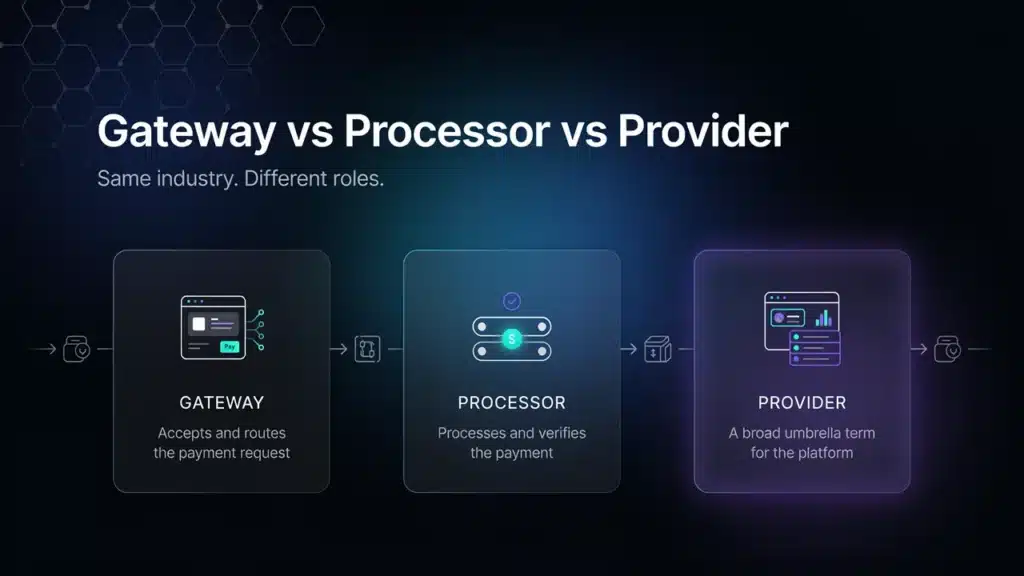
A payment gateway is the interface: the checkout page, the API, the piece of software that captures a payment request and passes it along. In card payments, the gateway talks to a processor and a bank. In crypto, the gateway is what generates the invoice, displays the wallet address or QR code, and detects when a transaction has landed.
The gateway is the part merchants interact with directly: hosted checkout pages, payment links, plugins for WooCommerce or WHMCS. It’s the front door.
A gateway alone doesn’t tell you where funds end up. That’s the processor’s job.
What a Payment Processor Actually Does
The processor is the layer that actually moves money. It handles settlement: confirming the transaction happened, matching it to an invoice, and determining where the funds land.
This is where the custodial vs non-custodial split lives, and it’s the single most important thing this article can tell a merchant evaluating crypto payment options:
- A custodial processor receives the crypto into its own wallet first, then credits your account internally. You don’t have the funds, you have a balance the processor says you’re owed. Withdrawal is a separate step, often gated by KYC, minimums, or processing delays.
- A non-custodial processor settles wallet-to-wallet. The customer’s payment goes directly to a wallet you control. There’s no internal ledger balance to withdraw. The funds are already yours the moment the transaction confirms.
Most of the well-known names in crypto payments, including Coinbase Commerce and BitPay, are custodial processors. They hold your funds until you withdraw them. This article goes deeper on why that distinction exists and what it costs merchants in practice.
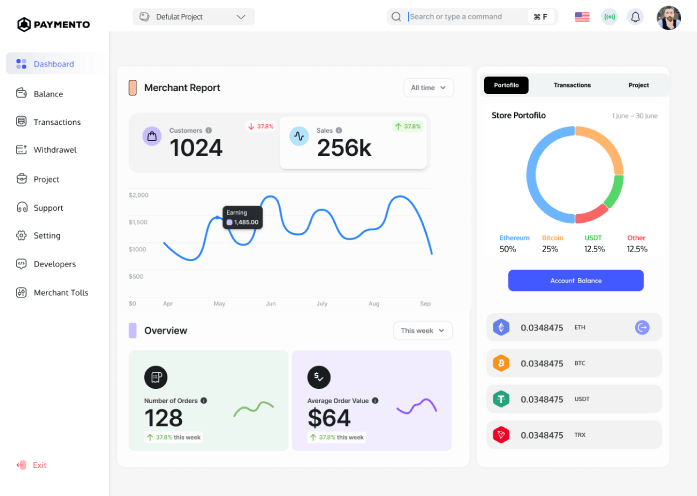
Paymento is a non-custodial processor. Settlement is wallet-to-wallet: the merchant’s wallet is the destination from the first payment, not a processor-controlled account you withdraw from later.
What a Payment Provider Means
“Provider” is the loosest of the three terms. It’s an umbrella word covering any company offering payment infrastructure, gateway, processor, or both bundled together. When someone searches “crypto payment provider,” they’re usually not distinguishing between the interface layer and the settlement layer at all. They’re asking a broader question: who should I use to accept crypto?
That’s a reasonable question to ask in those terms. But the useful follow-up question is narrower, and it’s the one this whole naming confusion tends to bury.
The Question That Actually Matters: Who Holds Your Funds?
Here’s a scenario that makes the distinction concrete.
A digital product seller runs a WooCommerce store selling software licenses. A customer pays $80 in USDT for a license key, delivered instantly and automatically since there’s nothing physical to ship.
With a custodial processor: the $80 in USDT lands in the processor’s wallet. The merchant’s dashboard shows a balance. To actually use that money, the merchant initiates a withdrawal, which might take a business day, might have a minimum threshold, and might require additional identity verification if the processor decides the account looks unusual. Until withdrawal completes, the processor is a counterparty the merchant is trusting to release funds correctly.
With a non-custodial processor: the $80 in USDT lands directly in the merchant’s own wallet the moment the transaction confirms on-chain. There is no withdrawal step, because there was never a hold to begin with. The merchant controls the private keys. Nobody else’s cooperation is required to access the funds.
Same $80 payment. Same customer action. A completely different relationship between the merchant and the money.
This is why “gateway vs processor vs provider” is the wrong first question for a merchant to spend time on. The right first question is: does this company touch my funds, or does it just facilitate the transaction between my customer and my wallet?
Why This Matters More for Specific Merchant Types
Hosting providers running WHMCS billing already deal with chargebacks as a routine cost of doing business. Traditional processors categorize hosting as high-risk, and disputes eat into thin margins. A custodial crypto processor reintroduces a version of the same problem: your funds sit with a third party until they decide to release them. A non-custodial setup removes that layer entirely. The WHMCS module settles straight to your wallet, and the irreversibility of the underlying blockchain transaction means there’s no dispute mechanism for a customer to exploit after delivery.
Digital product sellers face the sharpest version of the chargeback problem. A license key or download can’t be “returned,” but a customer can still file a dispute after receiving it, and processors often side with the customer by default. Non-custodial settlement doesn’t just remove custodial risk, it pairs with the irreversibility of crypto transactions to remove the dispute layer altogether.
Game server and gaming businesses run high transaction volume across a global, often crypto-native player base. A processor that holds funds and imposes withdrawal minimums or delays becomes a real operational drag at volume. Non-custodial settlement means every transaction clears independently, with nothing to reconcile against a processor’s internal balance.
A Quick Reference
| Term | What it describes | The question to ask |
|---|---|---|
| Payment gateway | The checkout interface where a customer enters or sends payment | Does it integrate with how I sell (hosted page, API, plugin)? |
| Payment processor | The layer that settles the transaction and determines fund destination | Custodial or non-custodial: does it hold my funds first? |
| Payment provider | Umbrella term for any company offering gateway and/or processor infrastructure | Is this specific provider custodial or non-custodial underneath? |
Every “provider” is built on a processor with an answer to that custody question, whether or not their marketing leads with it.
Where Paymento Fits
Paymento is gateway and processor in one non-custodial stack: hosted checkout, payment links, and a REST API on the gateway side; wallet-to-wallet settlement across Bitcoin, Ethereum, Tron, Solana, and Litecoin on the processor side. There’s no internal balance to withdraw, no custodial hold between a customer’s payment and a merchant’s wallet, and a 0.5% transaction fee regardless of integration method.
Check out fees and pricing here.
Start With the Custody Question
Before comparing gateways, processors, or providers by feature list, ask the one question that actually determines what you’re signing up for: when a customer pays, does the money go to a wallet you control, or to one the provider controls first?
Everything else, integration method, supported chains, fee structure, is easier to evaluate once that question is answered.
Start accepting crypto payments with Paymento. Non-custodial settlement, wallet-to-wallet, 0.5% per transaction.