Chargeback Protection for Digital Products: Why Crypto Payments Close the Gap
A customer buys your course, your plugin, your game key, or your SaaS subscription. They download it, use it, and thirty days later they open a dispute with their card issuer claiming the charge was unauthorized. You have no tracking number. No signature. No proof of physical delivery. You have a download log, and most issuers don’t weigh that heavily. You lose the dispute, lose the product, and lose the transaction fee on top of it.
This is the specific problem digital product sellers face that physical goods merchants mostly don’t. It isn’t rare. It’s structural, and it’s built into how card networks handle disputes.
Why Digital Products Are Uniquely Exposed to Chargebacks
Card networks built chargeback rules around physical retail: proof of shipment, proof of delivery, a signature at the door. Digital goods don’t produce any of that evidence. A download log or an API access record isn’t treated the same way by most issuing banks.
That gap is what makes digital goods a magnet for what the industry calls friendly fraud: a customer disputes a charge they authorized and received, betting that the merchant has no way to prove delivery in a format the bank recognizes. According to Wikipedia’s overview of chargebacks, first-party (friendly) fraud accounts for roughly a quarter of all chargebacks, and merchants globally win only about 21% of the disputes they contest. For digital goods specifically, without physical proof of delivery, that win rate is typically worse.
Every chargeback also costs more than the refunded amount. Card networks charge a dispute fee regardless of outcome, and processors often add their own penalty on top. Cross a chargeback ratio threshold and the processor can freeze the account entirely. That’s the exact scenario a lot of digital sellers eventually hit with Stripe or PayPal.
What “Chargeback Protection” Actually Means Here
Most tools marketed as chargeback protection are evidence-collection services: 3D Secure prompts, dispute-response templates, “verified by” badges, rolling reserves that hold back a percentage of every sale in case of a future dispute. They help you assemble a stronger case, or they hedge against the cost when you lose. They don’t remove the mechanism. The bank can still reverse the transaction; you’re just better prepared for it, or you’ve pre-paid for the loss through a reserve.
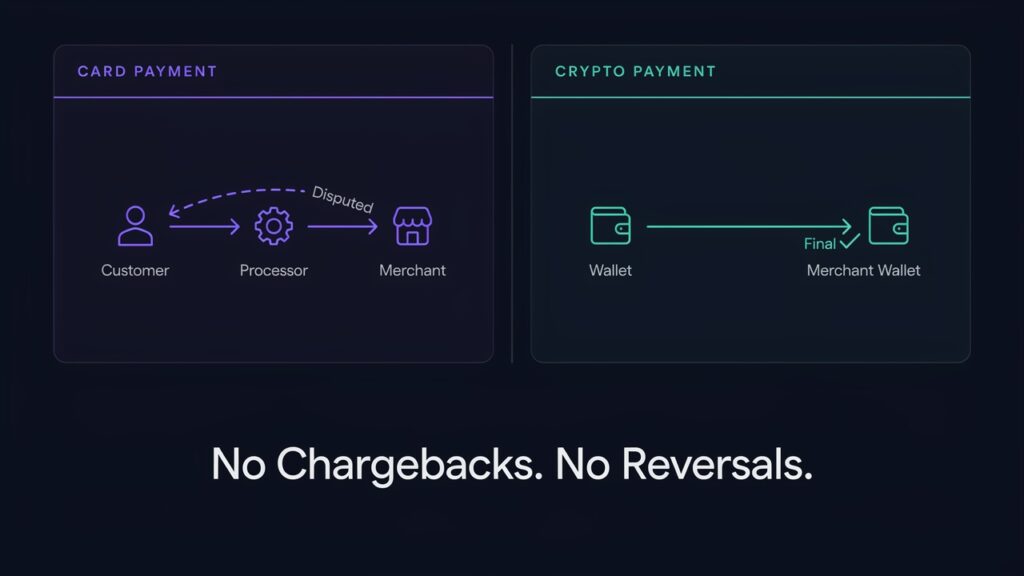
Crypto payments work differently because there’s no mechanism to remove evidence from. A card chargeback works because a bank can reverse a transaction it processed on the customer’s behalf. Crypto transactions settle wallet-to-wallet on a blockchain. There’s no intermediary account holding the funds that a bank can order reversed. Paymento merchants eliminate chargeback risk because the transaction that would need to be reversed doesn’t exist in a reversible form. The customer sends crypto directly to the merchant’s own wallet, and once confirmed, it’s final.
That’s a structural difference, not a policy or a service layer. It’s also why it doesn’t come with a “chargeback protection guarantee” badge, a reserve requirement, or a monthly fee. There’s simply no chargeback to protect against, and nothing to hold back in case one arrives.
What This Looks Like for a Digital Product Business
Take a solo developer selling a WordPress plugin through WooCommerce. Card payments go through Stripe. Every month, a handful of buyers file disputes weeks after downloading and activating the plugin. Support time goes into fighting disputes with a download log that Stripe’s dispute form barely has a field for. Most are lost.
With Paymento’s WooCommerce plugin, the same store adds crypto as a payment option at checkout. Stablecoins like USDT or USDC keep pricing predictable for both sides. A buyer who pays in crypto settles the purchase directly to the seller’s own wallet. There’s no processor account in between, no dispute window, and no chargeback fee eating into a $19 plugin sale. The seller still handles card payments for buyers who want them; crypto simply removes the riskiest slice of the buyer base from the chargeback pool entirely.
This matters more the smaller the ticket size. A $500 product can absorb the cost of fighting a dispute. A $15 digital download usually can’t. The support time alone exceeds the sale.
The same pattern shows up for course creators and SaaS founders selling subscriptions. A customer finishes a cohort-based course, then disputes the charge months later claiming they never accessed it, even though the platform’s own login records say otherwise. A SaaS founder on a monthly plan has a user cancel through a chargeback instead of the cancel button, because it’s faster and sometimes gets a refund the merchant would have contested if given the chance. Neither login records nor usage logs carry the same weight with an issuing bank that a tracking number does. The underlying problem is identical to the plugin example above: digital consumption doesn’t produce the kind of proof card networks are built to evaluate.
Traditional Chargeback Costs vs. Non-Custodial Settlement
| Card processor (standard) | Card processor + reserve | Paymento (non-custodial crypto) | |
|---|---|---|---|
| Dispute fee per chargeback | $15-$25, non-refundable | $15-$25, non-refundable | None, no dispute mechanism exists |
| Funds held pending review | Sometimes, at processor’s discretion | Yes, rolling reserve on all sales | No, funds settle to merchant wallet |
| Who can reverse a settled payment | Issuing bank | Issuing bank | No party can reverse a confirmed transaction |
| Account freeze risk from high dispute ratio | Yes | Reduced, still possible | Not applicable, no chargeback ratio to track |
This isn’t a claim that crypto payments are superior in every respect. Cards remain the default for a reason, and most digital sellers will keep accepting them. It’s a comparison of one specific failure mode: what happens when a buyer disputes a charge for a product they already received.
Setting This Up Without a Developer
Digital product sellers don’t need custom development to start. Paymento supports three integration paths depending on the store:
- WooCommerce plugin: install and configure crypto as a checkout option alongside existing card payments
- Payment links: for one-off sales, course platforms, or anywhere a hosted checkout URL works better than a plugin
- API integration: for sellers running a custom storefront who want crypto embedded directly in their own checkout flow
All three settle the same way: directly to the merchant’s own wallet, with the merchant holding the private keys the entire time. Paymento never takes custody of the funds at any point in the flow.
Doesn’t Crypto Pricing Volatility Create a Different Problem?
This is the objection that comes up first, and it’s a fair one. The fix is that the seller never has to price in crypto. Paymento supports fiat-denominated pricing: the seller sets the price in USD or EUR, and Paymento calculates the crypto equivalent at the moment of checkout. The buyer sees a price, pays the crypto amount matching it at that moment, and the seller’s books show the transaction at the price they set. Volatility between the sale and whenever the seller decides to convert their crypto is a separate question, and one entirely in the seller’s control, since the funds are sitting in their own wallet, not a processor’s holding account with a forced conversion schedule.
What Doesn’t Change
Crypto payments remove the chargeback mechanism, not every form of fraud. A buyer can still claim a download link never worked, or a license key was invalid. That’s a support conversation, not a chargeback. Crypto transactions are irreversible, which means refunds for legitimate customer service issues are the merchant’s call to make manually, not something a bank forces after the fact. For most digital sellers, trading unpredictable forced reversals for merchant-controlled refunds is the better trade, but it is a real tradeoff worth planning for, not a feature to gloss over.
It’s also worth being direct about scope: this addresses chargebacks specifically, the card-network reversal mechanism. It doesn’t touch KYC, tax obligations, or other compliance requirements a digital seller may have in their jurisdiction. Those exist independently of how a customer pays.
Where This Fits for a Digital Product Seller Evaluating Options
If chargebacks are an occasional nuisance, this may not be worth changing anything for. If they’re a recurring cost eating into margin on low-ticket digital goods, or the reason a processor has already flagged the account, non-custodial crypto payments address the actual mechanism, not just the paperwork around it.
Start accepting crypto payments with Paymento. Add WooCommerce, a payment link, or the API to your existing checkout, and keep card payments running alongside it.