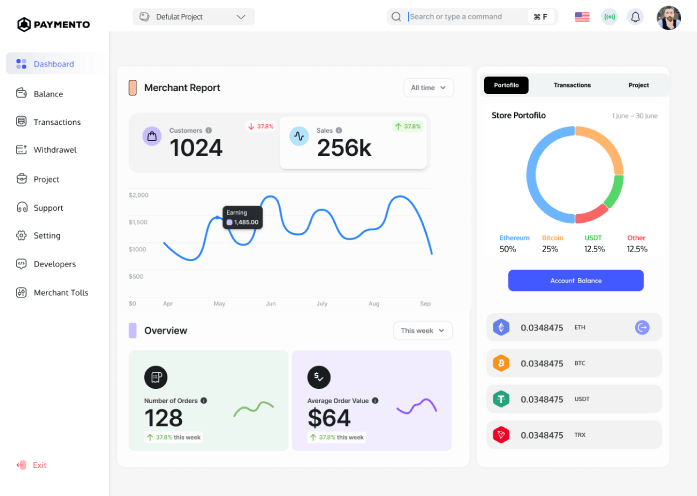
Paymento vs Coinbase Commerce: Which Crypto Payment Gateway Is Right for Your Business?
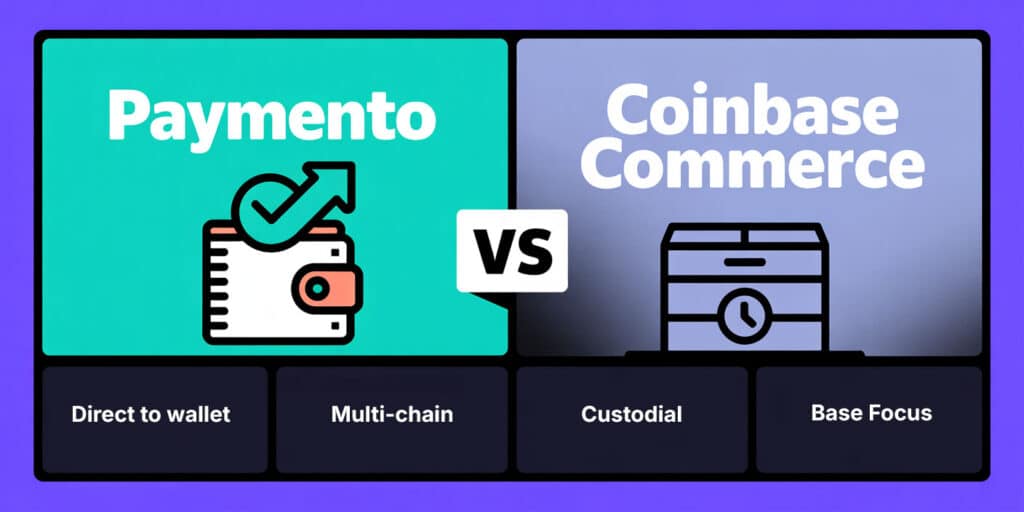
Coinbase Commerce is the name most merchants encounter first. Coinbase is one of the most recognized brands in crypto, and that recognition carries over to their commerce product, merchants assume that if they trust Coinbase for buying and selling crypto, they can trust Coinbase Commerce for accepting it.
That logic isn’t wrong. Coinbase Commerce is a legitimate product with real strengths. But brand recognition and the right tool for your specific business are two different things. And as crypto payments mature, the questions merchants are asking have gotten more specific: Who holds my funds between payment and settlement? Which chains do my customers actually use? What am I paying in fees that I don’t have to?
This guide compares Paymento and Coinbase Commerce on the dimensions that actually matter for running a business, not features for their own sake, but the practical implications of each product’s architecture, chain support, and fee structure. The goal is to help you make the right decision for your business, not to sell you on one option.
A Quick Overview of Both Products
Coinbase Commerce is a crypto payment gateway built and operated by Coinbase. It’s custodial, Coinbase holds incoming payments on your behalf and settles to you on their schedule. The product has historically supported multiple chains but has been moving aggressively toward a USDC-on-Base model, reflecting Coinbase’s investment in Base, their own Layer 2 blockchain. It integrates natively with Shopify and has solid brand recognition among merchants new to crypto.
In early 2026, Coinbase launched “Coinbase Payments” a broader commerce infrastructure play positioning Coinbase as a full-stack stablecoin payment solution for e-commerce platforms. The x402 Foundation, announced alongside it, targets AI-agent payments via the HTTP 402 standard. Both moves signal that Coinbase is building deeper into the Base ecosystem, consolidating their infrastructure around their own blockchain.
Paymento is a non-custodial crypto payment gateway. When a customer pays, the funds settle directly to the merchant’s wallet, Paymento never holds them. It supports multiple chains natively (Tron, Ethereum, BNB Chain, Solana, and others), which means merchants can accept USDT on TRC-20, ERC-20, BEP-20, and SPL from the same integration. It offers a WooCommerce plugin, a WHMCS plugin, payment links, Telegram subscription automation, and a full API. Payer email collection is optional customers can complete a payment without submitting any personal data.
The core difference is architectural: one product holds your money, the other doesn’t.
The Fundamental Difference: Custodial vs Non-Custodial
Before getting into features, this distinction needs to be understood clearly because everything else flows from it.
Coinbase Commerce is custodial. When a customer pays you via Coinbase Commerce, the funds go into Coinbase’s wallet first. Coinbase holds them, and you withdraw to your own wallet or bank account on their settlement schedule. Until you withdraw, the funds are Coinbase’s liability to you not your funds in your wallet.
Paymento is non-custodial. When a customer pays via Paymento, the funds go directly to your configured wallet address. The payment is yours the moment it confirms on-chain. Paymento never has possession of the funds at any point.
The practical implications of this difference are significant:
Settlement speed. With Coinbase Commerce, you receive your funds when Coinbase processes a withdrawal which involves their internal schedule, regardless of when the on-chain transaction confirmed. With Paymento, your funds arrive in your wallet at the same moment the blockchain confirms the transaction. For a TRC-20 USDT payment, that’s typically within three minutes of the customer paying.
Counterparty risk. With a custodial gateway, you’re exposed to the provider’s operational risk. If Coinbase experiences technical issues, regulatory action, or account-level flags, access to your funds is dependent on their resolution timeline. With a non-custodial gateway, your funds are in your wallet. Paymento’s operational status doesn’t affect your access to money you’ve already received.
Withdrawal fees. Coinbase Commerce charges fees to withdraw your funds because a withdrawal is a separate on-chain transaction that costs network fees, which are either passed to you directly or built into their fee structure. With Paymento, there’s no withdrawal transaction because the funds went directly to your wallet. That cost doesn’t exist.
Platform dependency. With a custodial model, your revenue is inside someone else’s platform until you withdraw it. With a non-custodial model, your revenue is yours the moment payment confirms.
Feature Comparison: Side by Side
| Feature | Paymento | Coinbase Commerce |
| Custody model | Non-custodial | Custodial |
| Settlement | Instant, direct to your wallet | Delayed — Coinbase settlement schedule |
| Chains supported | TRC-20, ERC-20, BEP-20, Solana, more | Primarily Base + limited others |
| USDT support | ✅ All major chains | Limited — USDC-first |
| USDC support | ✅ | ✅ (primary focus) |
| WooCommerce plugin | ✅ | ✅ |
| WHMCS plugin | ✅ | ❌ |
| Shopify integration | Via API | ✅ Native |
| Payment links | ✅ | ✅ |
| Telegram automation | ✅ | ❌ |
| API access | ✅ Full API | ✅ Full API |
| Payer KYC required | ❌ Not required | Sometimes required |
| Payer email required | ❌ Optional | ✅ Required |
| Withdrawal fees | None (non-custodial) | Yes |
| Counterparty risk | None | Present |
| Multi-chain USDT | ✅ | ❌ |
Chain Support: Why “Multi-Chain” Isn’t Just a Marketing Term
Coinbase’s recent product moves make their chain strategy clear: they’re building around Base, their own Ethereum Layer 2. Coinbase Payments runs on Base. The x402 standard is built on Base. USDC which Coinbase co-created is their preferred stablecoin.
This is a coherent strategy for Coinbase as a business. Base gives them transaction fee revenue, data, and ecosystem lock-in. For merchants, however, it creates a meaningful problem: your customers don’t all live in the Coinbase/Base ecosystem.
USDT on TRC-20 is the most widely used stablecoin network globally. Adoption is particularly dominant across Asia, the Middle East, Eastern Europe, and Latin America the same markets where crypto payment adoption is growing fastest. A merchant who only accepts USDC on Base is invisible to the majority of the world’s active stablecoin users.
Paymento supports USDT across all major chains from a single integration:
- TRC-20 (Tron): ~$1 fee, ~3 minute confirmation, highest global adoption
- ERC-20 (Ethereum): $5–50 fee (gas-dependent), 10–20 minutes, high adoption for large transactions
- SPL (Solana): <$0.01 fee, <30 seconds, fast-growing adoption
When you integrate Paymento, customers see every chain you’ve enabled at checkout and choose the one that works for their wallet. You receive payment in your wallet regardless of which chain they use. No chain selection logic on your end, the gateway handles it.
A merchant on Coinbase Commerce who wants to accept USDT from a customer holding TRC-20 USDT has a problem. That customer would need to bridge or swap their USDT to a Coinbase-supported chain before they can pay, which is friction that will kill the transaction for most buyers.
Fees: What You Actually Pay on Each Platform
Fee structures in crypto payments have a few layers that are worth separating clearly.
Gateway percentage fee. Both Paymento and Coinbase Commerce charge a percentage of each transaction. Coinbase flat fee is 1% per transaction and Paymento fee is half of that (0.5%).
Network fees (paid by the customer). When a customer sends crypto, they pay a network fee to the blockchain. This exists regardless of which gateway you use, it’s the cost of an on-chain transaction. Paymento’s non-custodial model means this is the only network fee in the transaction.
Withdrawal fees (the custodial hidden cost). This is where the custodial model creates a second layer of cost. With Coinbase Commerce, getting your funds out of Coinbase’s wallet requires a second on-chain transaction from their wallet to yours. This second transaction also has a network fee, either charged to you directly as a withdrawal fee or built into their fee structure. On Ethereum, a withdrawal transaction can cost $10–50 in gas. On Tron it’s approximately $1. Across a month of volume, these withdrawal fees add up.
With Paymento, there is no withdrawal transaction. Funds arrive directly in your wallet in a single transaction. There’s no second network fee because there’s no second transfer.
The practical fee comparison for a $100 USDT payment on TRC-20:
| Fee type | Paymento | Coinbase Commerce |
| Gateway % fee | ~$0.5 (0.5%) | ~$1 (1%) |
| Customer network fee | ~$1 (TRC-20) | ~$1 (TRC-20) |
| Withdrawal fee | $0 | ~$1 (TRC-20 withdrawal) |
| Total friction | ~$1.5 | ~$3 |
The difference widens significantly on Ethereum where withdrawal gas fees can add $10–50 per withdrawal event.
Coinbase’s Recent Moves: What They Mean for Merchants
The early 2026 Coinbase Payments launch is worth understanding as context for this comparison.
Coinbase Payments is positioned as a full-stack stablecoin commerce solution, starting with Shopify integration and built entirely on Base. The x402 Foundation, announced alongside it, is a long-term play for AI-agent-to-agent payments using HTTP 402 as a payment standard interesting technology, but years from meaningful merchant adoption.
What these launches confirm is the direction Coinbase is moving: deeper into their own ecosystem, more focused on Base and USDC, more enterprise and platform-level than direct-to-merchant.
For merchants who are building within the Coinbase/Base/Shopify ecosystem, this consolidation is convenient. For merchants who need multi-chain USDT support, custody of their own funds, or infrastructure that works outside the Coinbase ecosystem, these moves highlight the gap that non-custodial multi-chain gateways fill.
Who Should Choose Coinbase Commerce
Being honest about this matters. Coinbase Commerce is the right choice in specific situations:
Shopify merchants primarily serving US customers. The native Shopify integration is genuinely strong, and US customers are more likely to hold USDC than customers in other markets. If your store runs on Shopify and your customer base is US-centric, Coinbase Commerce’s ecosystem fit is real.
Merchants who want automatic fiat conversion managed by the platform. If you want to accept crypto and automatically receive USD in your bank account without thinking about wallets or chains, Coinbase Commerce’s custodial model actually makes this workflow simpler. You trade custody and control for operational convenience.
Businesses already embedded in the Coinbase/Base ecosystem. If you’re building on Base, using Coinbase products for treasury management, or your developer team is already integrated with Coinbase’s APIs, staying in the ecosystem has compounding benefits.
Merchants where brand trust is a customer-facing concern. In some markets, the Coinbase name on the payment flow provides reassurance to customers who recognize it. This is a softer factor but real for some businesses.
Who Should Choose Paymento
Merchants who want funds in their wallet immediately. If instant settlement, no withdrawal delays, and no counterparty risk are priorities which they should be for most businesses — non-custodial architecture is the answer.
WooCommerce store owners. Coinbase Commerce’s WooCommerce support is limited compared to their Shopify integration. Paymento’s WooCommerce plugin is a first-class product with active development.
WHMCS users. Hosting providers, domain registrars, and infrastructure businesses running WHMCS have a native Paymento integration. Coinbase Commerce doesn’t support WHMCS.
International merchants and businesses serving global customers. If your customers are in Asia, the Middle East, Eastern Europe, or Latin America, the majority of them hold USDT on TRC-20. You need TRC-20 support. Paymento has it; Coinbase Commerce’s Base-first model doesn’t prioritize it.
Privacy-focused businesses. Paymento’s optional email means customers can pay without submitting personal data. Coinbase Commerce requires email from payers. For VPN providers, privacy tools, and any business serving customers who specifically chose crypto for its pseudonymous properties, this distinction matters.
Businesses monetizing Telegram communities. Paymento’s Telegram automation — automatic member management on payment confirmation has no equivalent in Coinbase Commerce.
Developers building custom integrations. Both products have APIs, but Paymento’s non-custodial architecture gives developers more flexibility. You’re not building on top of a custodial layer with settlement windows and withdrawal logic to account for.
Migrating from Coinbase Commerce to Paymento
If you’re currently on Coinbase Commerce and want to switch, the process is straightforward.
What you need before starting: A crypto wallet with addresses for each chain you want to support. hardware wallet or non-custodial software wallet like SafePal Mobile wallet.
Step 1: Create your Paymento account at paymento.io. No KYC required to get started.
Step 2: Add your wallet addresses and XPub in the Paymento dashboard, one per chain. For TRC-20, ERC-20, BNB Chain, and Solana, you’ll configure four addresses. Each one is independent, and all can come from the same hardware wallet.
Step 3: Install the appropriate plugin. WooCommerce merchants install the Paymento plugin from the WordPress repository and connect their account. WHMCS users follow the WHMCS integration guide. Both processes take under ten minutes.
Step 4: If you use Coinbase Commerce payment links for invoicing or direct sales, recreate them in Paymento. The link generation is straightforward, enter the amount and currency, get a shareable link.
Step 5: Disable Coinbase Commerce in your store settings once Paymento is live and tested. Run a test transaction on each chain before switching production traffic.
What you gain immediately: Direct wallet settlement, no withdrawal fees, multi-chain USDT support, and optional payer email. What you may need to adjust: if you relied on Coinbase Commerce’s automatic fiat conversion, you’ll convert separately via your preferred exchange going forward.
Frequently Asked Questions
Is Paymento as reliable as Coinbase Commerce? Reliability in non-custodial payments works differently than in custodial ones. With Paymento, the funds arrive in your wallet directly. Paymento’s uptime affects transaction detection and notification, but your funds are never at risk inside the platform. With Coinbase Commerce, platform availability affects both transaction processing and access to settled funds. For most merchants, non-custodial architecture is more resilient, not less.
Can I use both Paymento and Coinbase Commerce simultaneously? Yes, technically. Some merchants run multiple payment options at checkout. In practice, maintaining two gateway integrations creates operational complexity without much benefit — most merchants switch rather than run both in parallel.
Does Coinbase Commerce support USDT on Tron (TRC-20)? Coinbase Commerce’s current product direction is focused on USDC on Base. TRC-20 USDT support is limited or unavailable depending on their current integration. For merchants whose customers predominantly use TRC-20 USDT which is the majority of global stablecoin users, this is a significant gap.
What happens to my funds if Coinbase Commerce experiences downtime or account issues? With a custodial model, your access to already-received funds is dependent on the platform’s availability. Account freezes, technical outages, or compliance reviews can delay access to settled funds. This is the core counterparty risk of custodial architecture. With Paymento, once funds confirm on-chain to your wallet, they’re yours regardless of Paymento’s operational status.
Is Paymento available in my country? Paymento is available globally. As a non-custodial gateway where funds settle directly to merchant wallets, geographic restrictions are minimal compared to custodial services that must comply with financial licensing requirements in each jurisdiction. Check paymento.io for any specific country restrictions.
Does switching from Coinbase Commerce affect my existing customers? No. From the customer’s perspective, crypto checkout looks similar regardless of which gateway is running it. They see a payment address and send crypto — the underlying gateway is invisible to them.
The Bottom Line
Coinbase Commerce and Paymento serve different merchant profiles, and the right choice depends on your specific situation.
If you’re a Shopify merchant primarily serving US customers who want to accept USDC with automatic fiat conversion and you value the Coinbase brand in your checkout flow, Coinbase Commerce is a reasonable fit.
If you want your funds to arrive in your wallet the moment a payment confirms, you need to accept USDT on TRC-20 (the most-used stablecoin network globally), you run WooCommerce or WHMCS, or you serve customers outside the US, Paymento is the stronger choice.
The custody question sits underneath all of it. A payment gateway that holds your money until it decides to release it is a fundamentally different product than one that sends it straight to your wallet. For merchants who’ve thought carefully about that difference, the answer tends to be clear.
Try Paymento — direct wallet settlement, multi-chain USDT, no withdrawal fees →