Lemon Squeezy Alternative When Stripe Isn’t in Your Country
On November 16, 2026, Lemon Squeezy announced it is winding down. New store sign-ups closed the same day, and the platform will stop processing payments on March 31, 2027. Most sellers are being pointed to Stripe Managed Payments, the merchant of record product the Lemon Squeezy team built inside Stripe.
For a lot of founders that is a migration project. For others, the shutdown email contained a harder line: Managed Payments isn’t available in their country. Many of those founders chose Lemon Squeezy in the first place because Stripe didn’t support them. Now the platform that worked around that problem is closing, and its replacement has the same gap.
This guide is for that second group. It covers what the shutdown means, which options actually exist when Stripe isn’t available where you’re based, and where crypto payments fit in, including where they don’t.
What the Lemon Squeezy shutdown means for your store
Here is what Lemon Squeezy has said publicly in its announcement:
- New stores: sign-ups closed on November 16, 2026.
- Existing stores: you can keep accepting payments until March 31, 2027. Lemon Squeezy says it won’t extend that date.
- If you’re moving to Stripe Managed Payments: migration tooling is due on December 2. Lemon Squeezy also notes that Managed Payments isn’t a like-for-like replacement, and that features such as digital fulfillment and storefronts need separate tools.
- If Managed Payments isn’t available where your business is based: you need to move to another provider. Lemon Squeezy offers a data export (customers, orders, subscriptions) and a migration intake form for help transferring card subscriptions.
That last group is who this post is for.
Why “Stripe isn’t available in my country” makes this harder
Lemon Squeezy was a merchant of record (MoR). Legally, it was the seller. It charged your customers, collected and filed sales tax and VAT in the countries where that applied, handled card disputes, and paid you out. That is why it could serve founders in countries Stripe doesn’t onboard directly: you were never Stripe’s customer, Lemon Squeezy was.
Stripe Managed Payments is also a merchant of record, but it has its own list of supported business locations. If your country isn’t on it, you can’t simply follow your store across.
Lemon Squeezy’s own suggestion for this case is to set up a company in a supported country, for example a US entity through Stripe Atlas. That works for some founders. It also adds a foreign company, its annual filings, a bank account in that country, and tax questions in two places. For a small SaaS or a solo app, that can cost more than the product earns.
So the real question isn’t “what is the best Lemon Squeezy alternative”. It’s “what can I actually sign up for from where I am, and what does each choice leave me responsible for?”
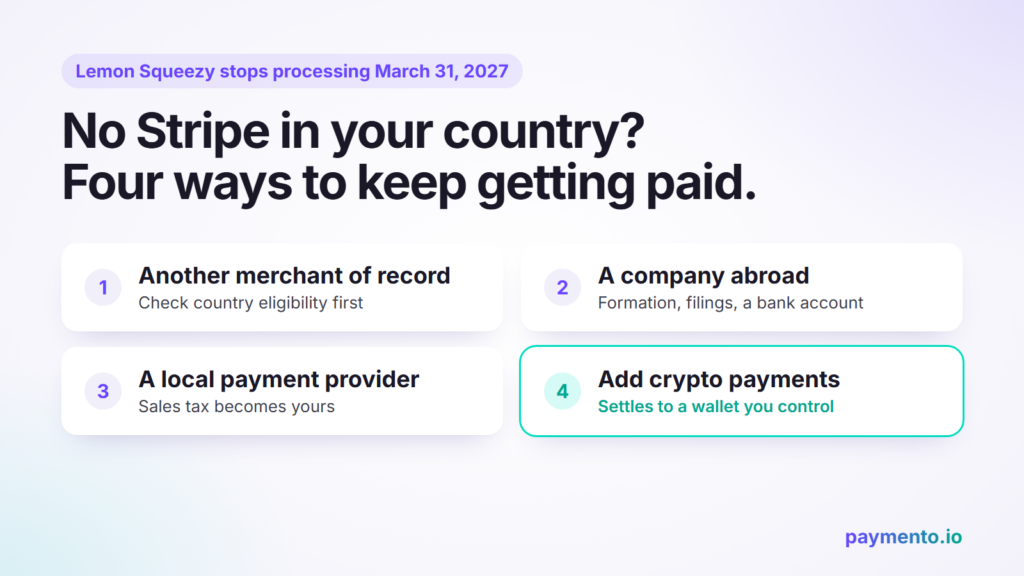
Your options if you can’t move to Stripe Managed Payments
1. Another merchant of record that supports your country
Several merchants of record serve software and digital product sellers. Before comparing fees or features, check two things, in this order:
- Do they accept businesses based in your country? This is the filter that matters, and it is usually on an eligibility or supported-countries page, not on the pricing page.
- Can they pay out to a bank account you can actually open? A provider that approves you but can only pay out in a currency or banking system you can’t reach doesn’t solve anything.
Then look at product category rules. Merchants of record are selective about what they sell for, and approval isn’t guaranteed even when your country is supported.
What you keep: someone else handles tax collection and filing. What you give up: the provider owns the customer relationship on paper, and if it closes or drops you, you’re back here.
2. Incorporate in a supported country
Covered above. It is a legitimate route, and it is the one Lemon Squeezy points to. Price it honestly before you start: formation, registered agent, annual filings, accounting in two jurisdictions, and the time to open a bank account.
3. A local or regional payment provider
Many countries have domestic payment companies that accept local businesses and settle to local banks. Some can charge international cards; many are strongest with domestic customers. If most of your customers are local, this may be the simplest answer. If they’re mostly abroad, check international card acceptance and currency support carefully.
With most of these providers you are the seller, so sales tax and VAT on international sales become your responsibility.
4. Add crypto payments alongside whatever you choose
Crypto payments don’t depend on which countries a card provider supports. A customer anywhere with a wallet or an exchange account can pay you, and a non-custodial gateway sends that payment to a wallet you control instead of holding a balance on your behalf.
Be clear about the limits before you plan around it:
- It isn’t a merchant of record. Tax on your sales stays with you, the same as option 3.
- Not every customer holds crypto. For most SaaS and digital products, crypto works best as a second payment option next to a card provider, not as the only one.
- Local rules vary. Some countries restrict or prohibit paying for goods and services in crypto. Check the rules where you and your customers are before you rely on it.
For founders who have just lost their only card option, a second rail that doesn’t depend on a card provider’s country list is worth having anyway.
Before you move: what to take with you
Whatever you pick, the checkout is the easy part to replace. The hard part is everything the old provider was holding. Do these before the deadline gets close:
- Export your data now. Customers, orders and subscriptions, using Lemon Squeezy’s export. Don’t wait for March.
- License keys. If Lemon Squeezy issued and validated your license keys, your app depends on it to stay unlocked. Moving license checks to your own server first means the payment change later only touches billing. This matters most for older app versions you can no longer update.
- Card subscriptions. Saved cards can’t simply be copied between providers. If you have active subscribers, fill in Lemon Squeezy’s migration intake form early and ask your new provider what it can import. Plan for some subscribers having to re-enter payment details.
- Your customer list. Keep a copy in your own database from now on, so the next change, if there is one, starts from your data instead of an export.
- What customers will see. The name on card statements and the receipt sender will change. Tell customers before the first renewal under the new provider, or expect disputes from people who don’t recognise the charge.
Where Paymento fits for SaaS and digital product sellers
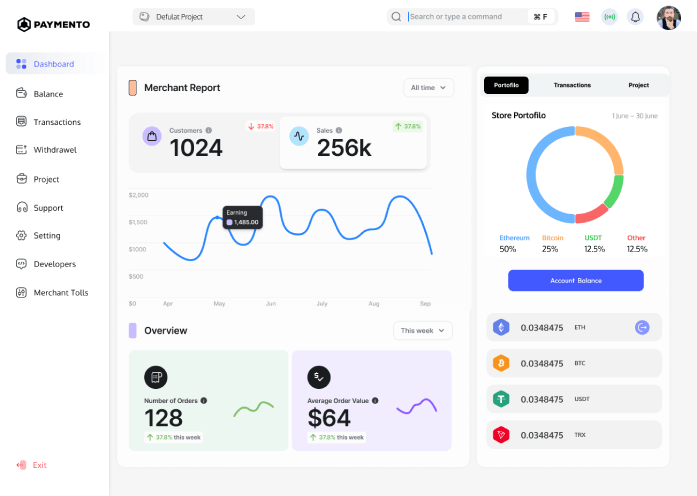
Paymento is non-custodial crypto payment infrastructure. It doesn’t replace a merchant of record, and it doesn’t process cards. What it does:
- Customers pay in crypto from almost anywhere. Bitcoin, Ethereum, Solana, and stablecoins like USDT and USDC on several networks.
- You keep your prices in dollars. Paymento works out the crypto amount at checkout, so you don’t re-price your store when markets move.
- Funds settle to a wallet you control. With a connect-your-own-wallet store, payments go directly to your own wallet. With an embedded wallet store, funds settle to a wallet only you can authorize, and you consolidate when you choose. Either way, Paymento never holds a balance that could be frozen. More on how that works in accepting crypto payments with Paymento.
- Your app can unlock access automatically. Your backend creates a payment through the REST API, sends the customer to Paymento’s hosted checkout, and receives a callback signed with HMAC-SHA256 once the payment is confirmed on-chain. That callback is where you issue or extend a license.
- Recurring billing through payment links. Payment links can repeat daily, weekly, monthly or yearly, with optional reminder emails and a grace period. Recurring billing isn’t available through the API or the plugins today, so if you need subscriptions, payment links are the way.
- Store plugins. WooCommerce, WHMCS, OpenCart, PrestaShop and Drupal. See crypto payment plugins.
- No identity documents to open an account. Paymento doesn’t require KYC to open a merchant account, because it never holds your funds. Your own regulatory and tax obligations in your jurisdiction are unchanged. Details on the crypto payment gateway without KYC page.
Pricing. Connect-your-own and seed-phrase stores are 0.5% per transaction. Embedded wallet stores are 0.5% + $0.20 per transaction. Fees are charged to your Paymento balance, not taken out of the customer’s payment, and new accounts start with $15 in free credit. Full details on fees and pricing.
Settlement isn’t instant. A payment counts once it’s confirmed on its network, and confirmation times vary by chain.
A realistic plan before March 31, 2027
- This week: export your customers, orders and subscriptions. Fill in Lemon Squeezy’s migration intake form if you have card subscribers.
- Next two weeks: shortlist providers by one filter only, whether they accept a business in your country and can pay out to you. Apply to two, not one.
- Before January: move license validation and your customer list to your own systems.
- Alongside: add a crypto option so customers who can’t or won’t pay by card still have a way to pay you, and so you’re not left with a single provider again.
- Before the switch: tell your customers what changes on their statement and receipts.
Frequently asked questions
When does Lemon Squeezy stop processing payments?
March 31, 2027. New store sign-ups closed on November 16, 2026.
What if Stripe Managed Payments isn’t available in my country?
You’ll need another provider. Lemon Squeezy’s options are to move to a different provider, with its help exporting data and transferring subscriptions, or to set up a company in a supported country.
Is Paymento a merchant of record?
No. Paymento is non-custodial crypto payment infrastructure. You remain the seller, and tax on your sales stays your responsibility.
Can I move my Lemon Squeezy subscribers to crypto payments?
Not automatically. Card subscriptions can’t be converted into crypto payments. You can offer subscribers a Paymento recurring payment link as an option, and they’d choose to pay that way.
Start before the deadline gets close
You have until March 31, 2027, but the founders who struggle with forced migrations are usually the ones who started in February. Export your data this week, apply to more than one provider, and give yourself a payment option that doesn’t depend on any single company’s country list.
Create a free Paymento account and add crypto as a payment option. New accounts start with $15 in free credit, and payments settle to a wallet you control.