Altcoin Payment Gateway: Which Coins Merchants Actually Need to Accept
Most altcoin payment gateways sell you on the length of their coin list. 200 coins, 300 coins, “every major token”.
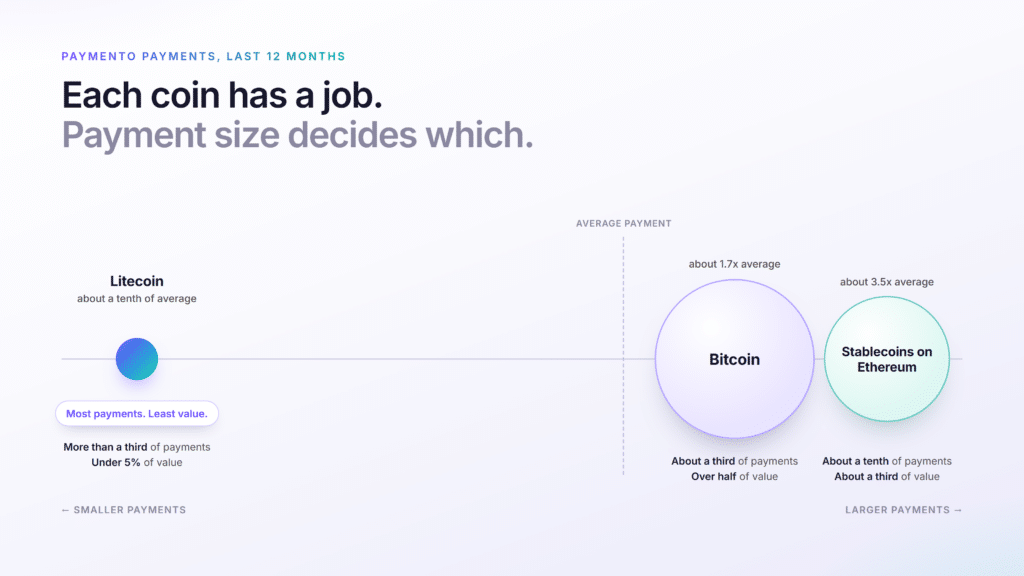
Our payment data points the other way. Over the last year, the coin used most often on Paymento was not Bitcoin and not a stablecoin. It was Litecoin, with more than a third of all payments. Yet Litecoin carried under 5% of the value that moved through Paymento.
That one gap says more about which altcoins to accept than any coin count. Customers don’t pick a coin at random. They pick it by how much they are paying.
What customers actually pay with
Here is the mix across Paymento over the last year, rounded:
| Asset | Share of payments | Share of value | Typical payment vs the overall average |
|---|---|---|---|
| Litecoin | More than a third | Under 5% | About a tenth |
| Bitcoin | About a third | Over half | About 1.7x |
| Stablecoins on Ethereum (USDT, USDC) | About a tenth | About a third | About 3.5x |
| Everything else | The rest | The rest | Varies |
Mainnet payments only. Rounded shares; we don’t publish payment counts or volumes.
Read down the last column and a pattern appears. Each coin has a job, and the job is set by payment size.
Litecoin is the small-payment coin. Its typical payment is about a tenth of the overall average. People use it for a server slot, a game item, a small download: purchases where a high network fee would be a large share of the price. Litecoin produces blocks about four times as often as Bitcoin, and its fees have stayed low, so it fits that role well.
Bitcoin is the value anchor. About a third of payments, but over half of the value. Its typical payment is larger than average. Customers paying in Bitcoin tend to be making a considered purchase, not an impulse one.
Stablecoins carry the large tickets. USDT and USDC on Ethereum are only about a tenth of payments, but about a third of the value, with a typical payment around three and a half times the average. When the amount is large, both sides want a dollar that stays a dollar between checkout and settlement. (Ethereum.org’s stablecoin guide explains how they hold their value.)
Everything else, including Ethereum’s own coin, Solana, Tron, Dogecoin and Bitcoin Cash, is a small slice. That’s not a verdict on those networks. It’s what our merchants’ customers chose over this period.
If stablecoins are the bigger part of your sales, here is how to accept USDT payments without the volatility problem.
What “altcoin” means at checkout
An altcoin is any cryptocurrency other than Bitcoin. In payments, the word covers two different things, and it helps to keep them apart:
- Altcoins as payment rails. Litecoin, Dogecoin and Bitcoin Cash work much like Bitcoin: each invoice gets its own address, and the coin itself is the payment.
- Tokens on a network. USDT and USDC are not separate blockchains. They are tokens that run on networks like Ethereum, Tron and Solana. When a customer pays in USDT, the network matters as much as the token.
That second point is where merchants get caught. A long list of “supported coins” often counts the same token on several networks as separate entries. What you need to know is simpler: which tokens, on which networks, can your customers actually pay with?
Why 300 coins is not a feature
A long coin list looks like reach. In practice, every coin you enable adds work that falls on you, not the gateway:
- Price exposure. A payment in a volatile altcoin is worth whatever that coin is worth when you sell or spend it. The longer you hold it, the more your revenue moves with a market you don’t control. Stablecoins avoid this. Thinly traded tokens make it worse.
- Reconciliation. Your books are in dollars or euros. Every extra coin is another price feed to record at the moment of payment, and another line your accountant has to explain.
- Wallets and keys. If funds go to your own wallet, every coin you accept is a coin your wallet setup must support and you must keep secure.
- Refunds. Crypto payments are irreversible, so a refund is a new payment you send. That’s easy in Bitcoin or a stablecoin. It’s harder in a token you hold a few dollars of and have to source first.
None of this means you should only accept one coin. It means each coin should earn its place by covering payments you would otherwise lose.
How to choose your altcoins
Start from your typical order size, not from a list.
Small, frequent payments (game servers, in-game items, small digital goods). Enable Litecoin. It is what small-ticket customers reach for. Add Dogecoin if your community already uses it.
Mid-size purchases (software licences, hosting plans, courses). Bitcoin plus at least one stablecoin. Bitcoin customers expect to be able to pay in Bitcoin, and a stablecoin covers anyone who’d rather not touch price risk.
Large invoices (B2B services, annual plans, agency work). Lead with stablecoins. USDT and USDC keep the amount stable from the moment the invoice is created.
Customers who hold a specific network. Offer the stablecoin on the network they already use, so they’re not forced to bridge or swap first. Paymento supports USDT on Ethereum and Tron, and USDC on Ethereum and Solana.
If your customers really need a coin that isn’t on that list, a processor built for broad coin coverage may suit you better. We’d rather say that plainly. You can compare crypto payment gateways side by side, with every competitor fact sourced.
What an altcoin payment provider should handle for you
Once you’ve picked a short list, the gateway’s job is to make those coins work without extra effort on your side. With Paymento:
- Payments go directly to your own wallet. Paymento is non-custodial and never takes custody of the funds, whichever coin the customer uses.
- Prices stay in your currency. You price in USD or EUR, and checkout shows the customer the amount in the coin they choose.
- One integration covers every coin. Bitcoin, Litecoin, Dogecoin, Bitcoin Cash, Ethereum, Tron and Solana run through the same hosted checkout, payment links and plugins for WooCommerce, WHMCS and OpenCart. You choose which coins your store accepts.
- Each UTXO payment gets its own address. On Bitcoin, Litecoin, Dogecoin and Bitcoin Cash, every invoice gets its own receiving address, and no address is shown to two customers at the same time, so each payment matches one order.
- Customers don’t need an account. They see the amount, an address and a QR code, and pay from their own wallet or an exchange.
- The fee doesn’t change by coin. Paymento charges 0.5% per transaction, billed to your Paymento balance rather than taken from the payment.
Settlement still depends on each network’s confirmation time, which differs from coin to coin. Paymento reports each payment’s status to your system as it moves from pending to confirmed.
The full, current list is on our supported assets page.
Game servers and small digital goods: one detail that matters
If most of your payments are small, the store type you choose matters as much as the coins.
Paymento offers two kinds of store. An embedded wallet store removes the wallet-connection step on Ethereum and Solana, and costs 0.5% plus $0.20 per transaction. A connect-your-own-wallet store costs 0.5% with no flat fee.
On a $40 plan the $0.20 is half a percent. On a $3 in-game item it is nearly seven percent. And on Litecoin, Bitcoin and the other UTXO coins, customers never connect a wallet anyway: they pay to a fresh address from any wallet. Litecoin works on both store types, so a game server that takes mostly small Litecoin payments usually gets the lowest cost from a connect-your-own-wallet store, while a seller of larger stablecoin orders may prefer the embedded store’s simpler checkout.
That is the kind of choice a coin count hides. A short list of the right coins, on the right store type, beats a long list nobody pays with.
For more on running payments for a game server, see our guide to crypto payments for game servers.
Frequently asked questions
What is an altcoin payment gateway?
A payment gateway that lets merchants accept cryptocurrencies other than Bitcoin, such as Litecoin, Dogecoin or Ethereum, and usually stablecoins like USDT and USDC. The gateway creates the payment request, shows the customer what to pay, and watches the blockchain for the payment.
Which altcoins should a merchant accept?
Match coins to order size. Litecoin for small payments, Bitcoin for mid-size purchases, and stablecoins for large invoices or price-sensitive customers. Add others only when customers ask for them.
Do I need to hold every altcoin I accept?
No. With a non-custodial gateway the coins arrive in your own wallet, and you decide whether to hold, convert or spend them. Stablecoins avoid most price exposure if you’d rather not hold volatile coins.
Does accepting USDT on Tron need anything extra?
Yes. On Tron, customers connect a wallet at checkout, on both store types. On Ethereum and Solana, embedded wallet stores let customers pay to an address and QR code without connecting.
Is a stablecoin an altcoin?
Technically, yes: anything other than Bitcoin is an altcoin. In practice, stablecoins behave very differently, because they track a currency like the US dollar instead of floating with the market.
Start with the coins your customers use
Pick the two or three coins that match your order sizes, connect a wallet you control, and add more only when customers ask.
Everything else you need to accept crypto payments on your site is in one place.
Create your Paymento store and choose your coins. New accounts get $15 of free credit toward Paymento fees.