Accepting Crypto Payments for Game Servers and Gaming Businesses
Game server hosts and gaming businesses run into a payments problem most industries don’t: a global, high-volume, small-ticket customer base that traditional processors were never built for. Players are everywhere. Purchases are frequent and small. And processors, seeing a category with historically high chargeback rates, respond by flagging gaming as high-risk before evaluating an individual business at all.
Crypto solves a meaningful part of this, but not because it’s exciting or new. It solves it because non-custodial settlement removes two specific structural problems: geographic payment coverage and chargeback exposure.
Why Gaming Gets Flagged as High-Risk by Default
Card networks and processors classify merchant categories by historical dispute rates, not by individual merchant behavior. Gaming, alongside hosting and digital goods, carries a reputation for disputed transactions, refund requests, and account holds. A new game server business inherits that reputation before processing a single payment.
The practical result: higher processing fees, reserve requirements, sudden account reviews, and in some cases outright rejection. None of this is about whether a specific business runs a clean operation. It’s a category-level risk score applied uniformly.
The Global Coverage Problem Cards Can’t Solve
A game server business or in-game item shop has players everywhere, not just in markets with reliable card infrastructure. Card acceptance varies enormously by country. Some players don’t have a card at all. Others have one that gets declined for cross-border transactions their bank flags as suspicious.
Crypto sidesteps this by design. A player anywhere with a wallet and an internet connection can pay. There’s no acquiring bank in the loop deciding whether to authorize a cross-border transaction, no currency conversion friction, no regional card network gaps. Coverage is the same in every market a player is in.
Chargebacks on In-Game Purchases: A Structural Problem, Not a Policy One
Digital goods and in-game purchases share the same core vulnerability: nothing physical changes hands, so there’s no delivery confirmation a processor can point to. A player buys in-game currency, cosmetics, or a server slot, receives it instantly, and can still file a chargeback afterward. Processors frequently side with the disputing customer by default, because proving digital delivery is harder than proving a package arrived.
At gaming’s transaction volume, even a small chargeback rate compounds into real revenue loss and processing account risk.
Crypto transactions are irreversible once confirmed on-chain. There’s no dispute mechanism sitting between confirmation and settlement, because there’s no intermediary holding the funds to reverse. This isn’t a policy decision a processor could change tomorrow. It’s a property of how the transaction settles.
What This Looks Like for a Game Server Business
Consider a game server hosting operator running automated recurring billing through WHMCS, with players across dozens of countries paying for server rental, slots, or add-ons.
With a traditional processor, cross-border cards get declined at a meaningfully higher rate than domestic ones, chargebacks on disputed rental periods are a recurring cost, and the merchant account itself carries ongoing high-risk category scrutiny.
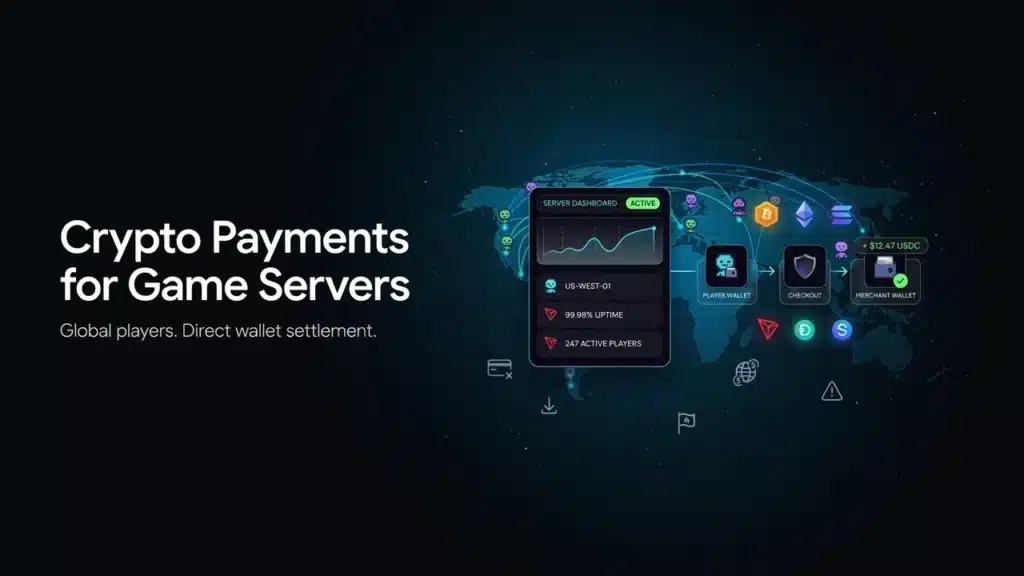
With non-custodial crypto payments through the WHMCS module, a player anywhere pays into an invoice, the transaction is monitored for confirmation, and funds settle directly into the operator’s own wallet. No processor sits between the payment and the wallet holding a balance the operator has to withdraw. No category-level risk score applies to the transaction itself, because there’s no card network involved.
The same logic applies to an in-game item shop selling cosmetics or currency bundles at high volume and low ticket size: Crypto payment API lets a storefront settle each purchase directly through the API without card-network chargeback exposure sitting on every sale.
Why Multi-Chain Support Matters More for Gaming Than Most Categories
Gaming audiences are more likely than most merchant categories to already hold crypto and have a preferred chain. A player base spanning Bitcoin holders, Ethereum users, and Solana-native gamers isn’t unusual. A gateway that only supports one chain forces a subset of players to convert or abandon the purchase.
Paymento supports Bitcoin, Ethereum, Tron, Solana, Litecoin and many more under a single integration, so a game server business doesn’t have to choose which chain to support at the expense of players who use a different one.
The Fee Math at Gaming’s Transaction Volume
Gaming businesses process a high number of small transactions, which makes per-transaction fees matter more than they do for merchants with fewer, larger purchases. Card processing for high-risk categories frequently runs well above standard rates once category surcharges and reserve requirements are factored in. Paymento charges a flat 0.5% transaction fee regardless of integration method.
One Thing Worth Knowing Before You Switch
Ethereum, Tron, and Solana are account-based chains, which means a player connects a wallet at checkout rather than sending to a generated address the way Bitcoin or Litecoin payments work. For a subset of players unfamiliar with wallet connection flows, this is a small added step compared to a card form. It’s a real piece of friction today, and it’s the specific problem non-custodial embedded wallet infrastructure (in progress on Paymento’s roadmap) is built to remove without reintroducing custody.
Getting Started
For automated recurring billing, the WHMCS module is the fastest path: Installing WHMCS plugin. For a custom storefront or in-game shop, the API integrates directly into existing purchase flows: API Documention. Either way, settlement is wallet-to-wallet from the first transaction, not a balance sitting in a processor’s account.
Start accepting crypto payments for your game server business. Global coverage, no chargebacks, 0.5% per transaction.