Coinbase Commerce Alternative: Where to Move After the Shutdown
Coinbase Commerce no longer exists as a standalone product. Coinbase unified it into Coinbase Business, and merchants had until 31 March 2026 to move. After that date, Coinbase says, the Commerce portal became inaccessible and no new charges could be created.
If you used Commerce, you are now choosing what replaces it. This guide sets out what changed, what Coinbase offers instead, and where a non-custodial gateway like Paymento fits. Every Coinbase detail below comes from Coinbase’s own transition guide, read on 12 October 2026.
What actually changed
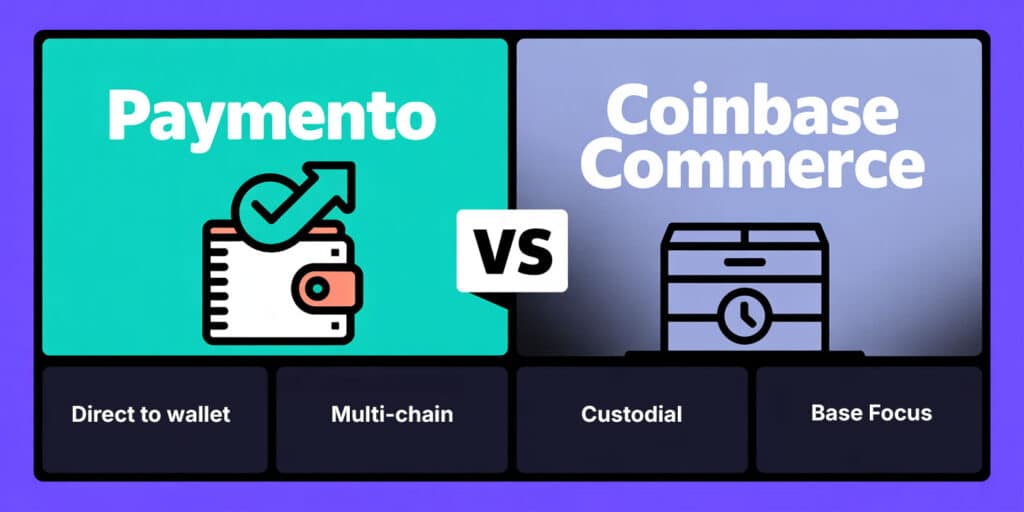
The detail most write-ups miss is custody. According to Coinbase, Commerce wallets were self-custodial: each merchant held a 12-word seed phrase, and Coinbase had no access to it or to the funds. Coinbase Business, which replaces it, is described by Coinbase as custodial, with bank off-ramps, payouts and accounting integrations.
So the move is not only a new dashboard. A merchant who chose Commerce because they held their own keys is being offered a product where Coinbase holds the funds. For some businesses that is an upgrade. For others it is the opposite of why they signed up.
- Where Coinbase Business is available: businesses with a legal entity in the United States or Singapore. Coinbase says it is expanding to more countries during 2026, and told merchants elsewhere to move to another provider.
- What it needs from you: a registered business entity and a business bank account.
- What it costs: 1% for migrating merchants, the same as Commerce’s 1% transaction fee.
- What you can accept: USDC today, with USDT listed as coming soon, on EVM networks.
Coinbase Business or a non-custodial gateway?
| Coinbase Commerce (closed) | Coinbase Business | Paymento | |
|---|---|---|---|
| Custody | Self-custodial (your seed phrase) | Custodial | Non-custodial (your wallet, your keys) |
| Status | Closed 31 March 2026 | Live for US and Singapore entities | Live |
| Fee | 1% | 1% for migrating merchants | 0.5% (+ $0.20 on embedded wallet stores) |
| Networks and stablecoins | Ethereum, Polygon, Base | EVM networks; USDC, USDT coming soon | USDT on Ethereum and Tron, USDC on Solana |
| Bank off-ramp | No | Yes | No: crypto arrives in your wallet |
| To open an account | Not applicable | Registered business entity and business bank account | No KYC; an email and a wallet |
Paymento does not require KYC to open a merchant account, because it never holds your funds. Your own regulatory and tax obligations in your jurisdiction are unchanged.
Choose Coinbase Business if
- Your business is registered in the United States or Singapore.
- You want Coinbase to hold the funds and pay them out to your bank.
- USDC covers what your customers pay with.
- Accounting integrations and payouts in the same account matter more to you than holding your own keys.
Choose Paymento if
- You chose Commerce because it was self-custodial, and you want to keep it that way. With Paymento, payments land directly in your own wallet, and Paymento never takes custody.
- Your customers pay in USDT, Bitcoin or other coins beyond USDC. Paymento supports Bitcoin, Ethereum, Tron, Solana, Litecoin, Dogecoin and Bitcoin Cash, with USDT on Ethereum and Tron and USDC on Solana.
- You want a 0.5% fee, billed to your Paymento balance instead of taken from each payment.
- You want customers to pay by QR code without connecting a wallet. Embedded wallet stores do this on Ethereum and Solana; Tron still needs a connected wallet.
Before you move: getting your Commerce funds out
Coinbase warned Commerce merchants about a specific problem. Commerce created a new address for every payment, and a standard wallet only scans the first 20 unused addresses. Importing a Commerce seed phrase into an ordinary wallet may therefore show only part of the balance, especially for Bitcoin and other UTXO coins. If you still hold a Commerce seed phrase, use a wallet that lets you raise the address gap limit, and check Coinbase’s guide for recovery options.
Paymento was built with this exact problem in mind. On bring-your-own-wallet Bitcoin stores, an address that expires unpaid waits days before it is offered again, and the same address is never shown to two customers at once. That keeps the gap between used addresses short, so your own wallet finds every payment without special recovery steps.
Moving a Commerce integration to Paymento
- Set up your wallet. Connect a wallet you already control, by xpub for Bitcoin or public address for other chains, or create an embedded wallet store protected by your passkey. New accounts get $15 of free credit.
- Replace charges with payment requests. Your backend creates each payment through the Paymento API and sends the customer to Paymento’s hosted checkout. On WooCommerce, WHMCS or OpenCart, install the plugin instead.
- Replace webhooks. Paymento sends payment status to your callback URL, signed with HMAC-SHA256, and a verify endpoint confirms each order before you fulfil it.
- Reissue payment links. Any Commerce checkout links you shared stopped working with the portal. Create Paymento payment links to replace them.
Questions merchants are asking
Can I still use Coinbase Commerce?
No. Coinbase says the Commerce portal became inaccessible after 31 March 2026 and no new charges can be created.
Was Coinbase Commerce custodial?
No. Coinbase describes Commerce wallets as self-custodial, controlled by the merchant’s seed phrase. Its replacement, Coinbase Business, is custodial.
Is Paymento cheaper than Coinbase Business?
On published rates, Paymento charges 0.5% and Coinbase Business charges migrating merchants 1%. The products are not the same: Coinbase Business includes custody and a bank off-ramp, which Paymento does not offer.
Can I build my own checkout with Paymento’s API?
Not today. The API creates the payment from your backend, and the customer completes it on Paymento’s hosted checkout before returning to your site.
Comparing other gateways too? Every comparison we publish, sourced the same way, is on our compare page, and our guide to the best crypto payment gateway for your business covers the wider field. For stablecoin-specific setup, see the stablecoin payment gateway.